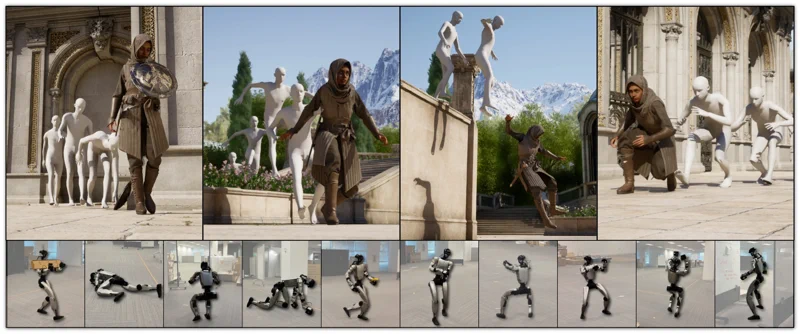
In a move that further blurs the line between simulation and the real world, NVIDIA, Inc. has unveiled MotionBricks, a real-time motion generation AI that uses a single model to animate both video game characters and physical humanoid robots. The system boasts a blistering 15,000 frames per second throughput with just 2 milliseconds of latency, effectively generating fluid, complex movements faster than a game engine can even request them.
The technology, detailed in a paper for SIGGRAPH 2026, moves beyond traditional animation state machines by using a generative model trained on a massive dataset of over 350,000 motion clips. MotionBricks can generate movement based on the last few poses and a target pose, allowing for dynamic, real-time character control. This is supercharged by “Smart Primitives,” which are modular motion skills like jumping, sitting, or picking up objects that can be combined like Lego bricks without needing to retrain the model.

But MotionBricks isn’t just a fancy new tool for game developers. NVIDIA demonstrated the same model providing whole-body control for a real Unitree G1 humanoid robot, running on a Jetson Orin module. This real-world application is where things get serious, as MotionBricks already serves as the core motion generation layer for NVIDIA’s ambitious Project GR00T, a foundation model for general-purpose humanoid robots.
Why is this important?
MotionBricks represents a fundamental shift for two industries simultaneously. For game development, it signals the beginning of the end for rigid, hand-authored animation trees, promising more dynamic and responsive characters that can interact with their environments in unscripted ways. For robotics, it’s a critical piece of the sim-to-real puzzle, allowing skills learned and refined in simulation to be deployed directly onto physical hardware with greater fidelity.
NVIDIA has released the code on GitHub and pretrained models on Hugging Face, a move celebrated by the community. However, in a classic case of giving with one hand while holding back with the other, the license for the underlying motion data is restricted to “internal evaluation only.” So while you can build the engine, you can’t legally use it for a commercial joyride just yet. For those wanting the full technical breakdown, the research paper is available on arXiv. This is one set of building blocks that could construct the future of both virtual and physical beings.