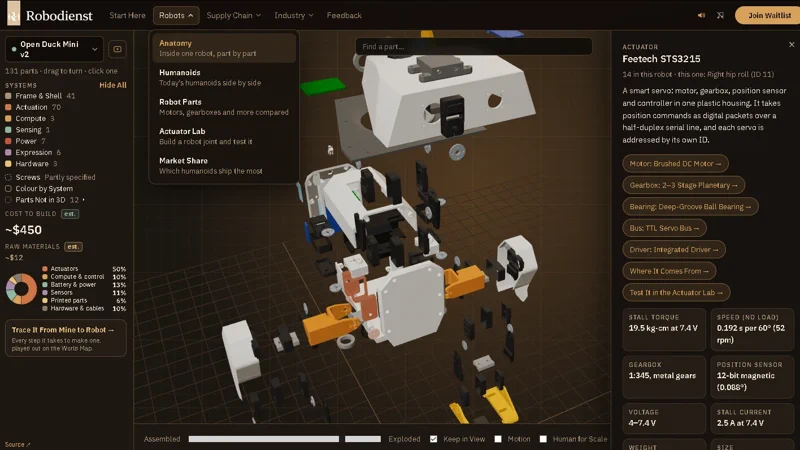
If you’ve ever found yourself awake at 3 AM wondering about the specific grade of neodymium used in a humanoid robot’s actuator, your oddly specific prayers have been answered. A new, startlingly comprehensive, and entirely free tool called Robodienst has launched, offering an interactive encyclopedia of the entire humanoid robotics industry. It’s the kind of obsessive-compulsive data visualization we can get behind.

The platform, available at the Hyperlink: Robodienst website, allows users to virtually disassemble over 40 different humanoid robots in 3D, from well-known models to obscure open-source projects. You can click on any component to see its materials, manufacturing process, and even play with interactive explainers that detail how motors and gearboxes function. The site maps the full supply chain for these complex machines, tracing components from 291 mines and factories across the globe and simulating how a single shortage can ripple through the industry. It’s all backed by a library of over 3,100 published sources.
The creator, Stevy Vng, built the tool to scratch his own itch of constantly collating scattered industry data. The feature set is frankly absurd for a free product. Users can access an “Actuator Lab” to build their own virtual joints, browse a historical database of over 60 supply chain shocks since 1978, and compare market share data to see which companies are currently dominating shipments. According to the site, the top five manufacturers—all Chinese—accounted for 86% of humanoids shipped in the first half of this year.
Why is this important?
Robodienst demystifies a notoriously opaque and capital-intensive industry, making high-level supply chain and engineering knowledge accessible to everyone from students to seasoned analysts. While the tool itself will remain free, the creator plans to fund the project through paid, small-group workshops—starting with hands-on sessions to take apart a real Unitree G1—and an exclusive online community. This platform isn’t just a curiosity; it’s a powerful educational and market intelligence resource that could significantly lower the barrier to entry for the next generation of roboticists.