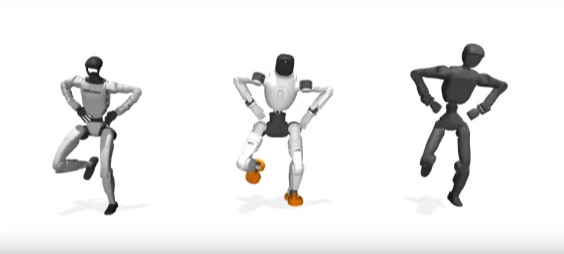
Training a new AI controller for every unique robot body is one of the most tedious and expensive chores in robotics. Researchers from the California Institute of Technology and Georgia Institute of Technology are tackling this problem with MorphMimic, a single, shared AI policy designed to control humanoids with wildly different bodies. The system allows robots like the Unitree G1, AgiBot X2 Ultra, and Booster T2 to perform complex movements from a massive library of 128,786 motion clips using the exact same set of neural network weights.
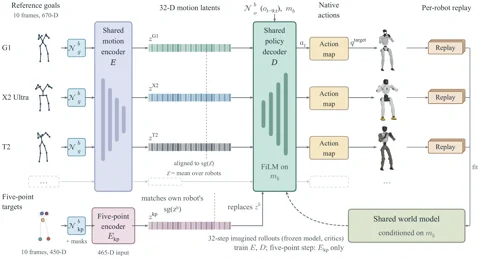
The magic behind MorphMimic is its ability to understand and adapt to a robot’s physical form, or morphology. It builds on the principles of SuperMimic, a highly efficient method for training robots by having them practice inside a learned, differentiable world model. MorphMimic extends this by first mapping each robot’s joints onto a “canonical layout,” creating a common language for movement. Then, a 125-value descriptor detailing the robot’s specific actuation, geometry, and mass is fed into the shared policy network. This descriptor essentially tells the AI, “You’re driving a tall, heavy robot with powerful legs today,” allowing it to generate the correct motor commands for that specific body. The project’s code is detailed in a public GitHub repository.
Why is this important?
This research represents a crucial shift from bespoke, single-robot controllers to generalist AI “brains” that can be dropped into new hardware. Instead of starting from scratch, a single, powerful policy can be adapted to a new robot simply by providing its physical specifications. This dramatically lowers the barrier to entry for developing and deploying new humanoid platforms. As demonstrated in the project’s research paper, a unified model trained on three different robots performs nearly as well as specialist models trained on each one individually, proving the concept’s viability. This is a significant step toward a future where robot “skills” are as portable as software, freeing hardware designers to innovate without worrying about rewriting the entire control stack.