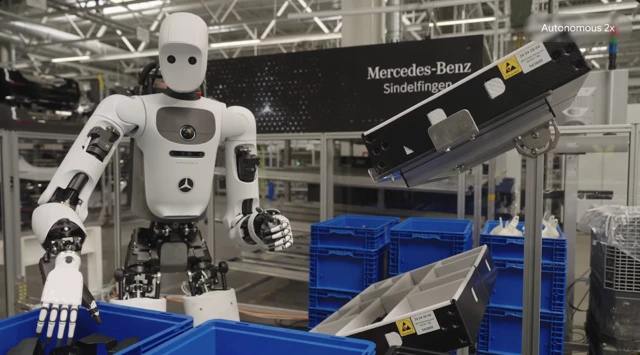
Google DeepMind just cranked the difficulty dial on industrial automation. On November 10, the company unveiled Gemini Robotics 2.5, its latest vision-language-action (VLA) model, and it’s already on the job. In a pilot program that should have factory managers everywhere sweating, the new AI is powering Apptronik’s Apollo humanoids on the production lines of Mercedes-Benz.
The headline-grabbing result from this metallic partnership is a 96% success rate in a real-world automotive kitting task. The Apollo robots, running Gemini 2.5, were deployed at Mercedes-Benz plants in Sindelfingen, Germany, and Kecskemét, Hungary, where they picked metal brackets from bulk bins and placed them into sequencing trays for the assembly line. This isn’t just a lab demo; it’s a proof-of-concept on an active production line for one of the world’s most demanding automakers. According to DeepMind, the new model demonstrates a 30% to 100% higher success rate and is 20% to 30% faster across more than 200 tested tasks compared to previous versions.
The Apollo humanoid, standing 5-foot-8 and weighing 160 pounds, is designed to work in spaces built for humans, lifting payloads up to 55 pounds. The pilot at Mercedes-Benz actually uses two AI models in tandem: a Gemini Robotics ER (Embodied Reasoning) model manages the overall workflow, while Gemini Robotics 2.5 handles the fine motor control for the arms and hands. DeepMind also emphasized safety improvements, noting that new guidance capabilities boosted safe task completion by 33% around obstacles and 43% around people.
Why is this important?
This isn’t just another robot in a factory. It’s a clash of titans, pitting Google’s AI brain against rivals in the race to create a viable, general-purpose humanoid workforce. While other companies are showcasing impressive demos, Google, Apptronik, and Mercedes-Benz are stress-testing their solution on a live luxury car production line.
The 96% success rate is a formidable benchmark, but as DeepMind acknowledges, “the road from 96% to 99.9999% is going to be steep.” That remaining 4%—representing fumbled parts or incorrect placements—is the brutally difficult gap between a promising pilot and a scalable, lights-out manufacturing solution. Still, by deploying a humanoid that can learn and adapt rather than just repeat a single, rigid program, this collaboration is a significant leap toward a future where robots don’t just replace rote tasks but handle complex, variable work alongside humans.