A quartet of industry heavyweights has joined forces to tackle one of the most stubbornly manual tasks in automotive manufacturing. Audi AG, robotics unicorn Agile Robots, simulation giant Dassault Systèmes, and AI powerhouse NVIDIA announced a proof-of-concept to deploy mobile humanoid robots at Audi’s Ingolstadt, Germany plant. The mission: automate the grueling parts-sequencing process, a logistical ballet that involves around one million picks every single day.
The project, unveiled at NVIDIA GTC Berlin, aims to solve a problem that has plagued automation experts for decades: reliably picking a wide variety of unsorted, sometimes flexible, parts out of containers. At Audi’s “Production Lab,” mobile humanoids from Agile Robots will be tasked with grabbing components and placing them in the precise sequence needed for final assembly. Before a single physical robot rolls onto the factory floor, the entire workflow is being meticulously simulated in a virtual twin of the plant. This digital rehearsal is built on Dassault Systèmes’ 3DEXPERIENCE platform and its DELMIA application, using NVIDIA Omniverse libraries to ensure the simulation is physically accurate.
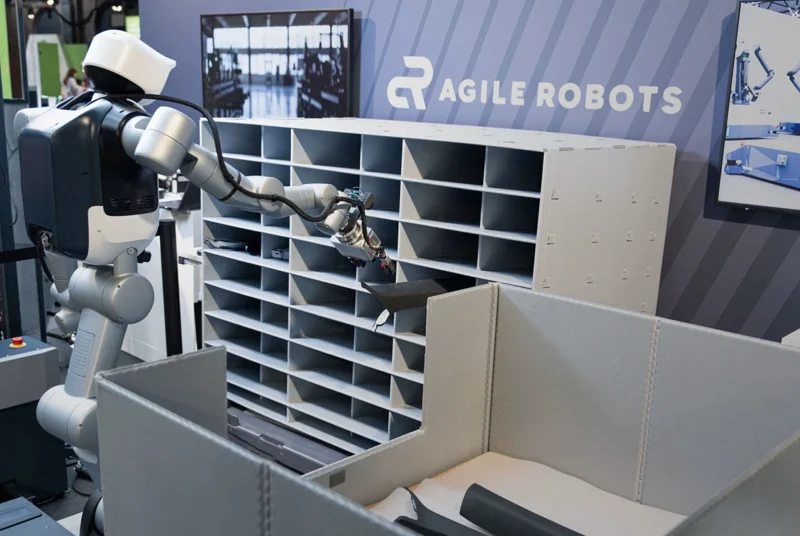
The star of the show is the mobile humanoid from Munich-based Agile Robots. Combining a mobile base with dual arms, the robot operates at human height, allowing it to slot into existing infrastructure without requiring a complete factory overhaul. Its AI-powered perception and dual-arm manipulation are designed specifically to handle the complex and variable parts that have traditionally defeated rigid automation, essentially solving the industrial equivalent of finding a specific Lego in a giant, unsorted bin.
Why is this important?
This collaboration is more than just a flashy pilot program; it’s a significant indicator of where industrial automation is headed. First, it validates the “simulation-first” approach. By using a sophisticated virtual twin, Audi can de-risk the project and slash deployment time from months to days, proving the business case for the industrial metaverse. Second, it’s a major commercial validation for mobile humanoids in a real-world, high-stakes environment beyond scripted demos. For decades, sequencing has been too complex for traditional robots, but this project suggests that “Physical AI” is finally ready to graduate from the lab.
For Audi, this is a concrete step toward its “thinking factory” concept, offloading repetitive, ergonomically challenging tasks from human workers to their robotic counterparts. If successful, this proof-of-concept could provide the blueprint for automating one of the most critical and labor-intensive processes in automotive logistics, fundamentally changing the calculus of car manufacturing.