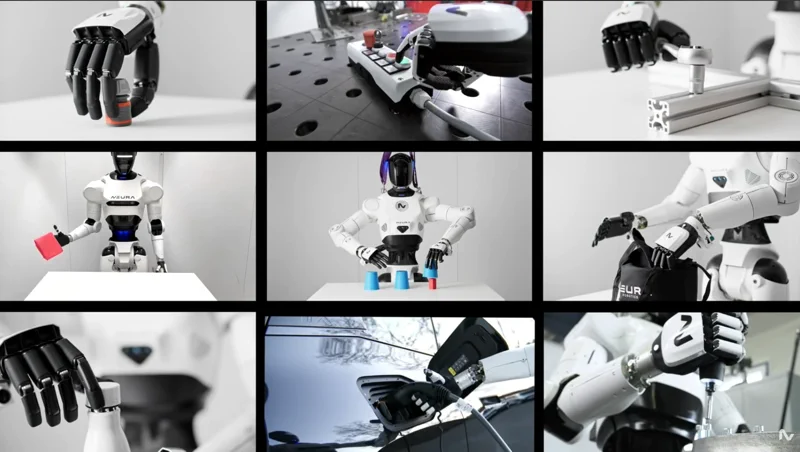
In a bold move from Metzingen, Germany—a town more famous for fashion outlets than foundation models—Neura Robotics has officially unveiled Neuron AI. The company is audaciously calling it the “world’s leading and only multimodal foundation model” for Physical AI, a claim designed to put the rest of the robotics world on notice. Backed by a massive $1.4 billion funding round, Neura is betting it has built the one true brain for every robot body.
“An intelligent robot needs a brain that brings its senses together and remembers what happened,” said David Reger, Founder and CEO of Neura Robotics. With Neuron AI, the company says it’s building exactly that.
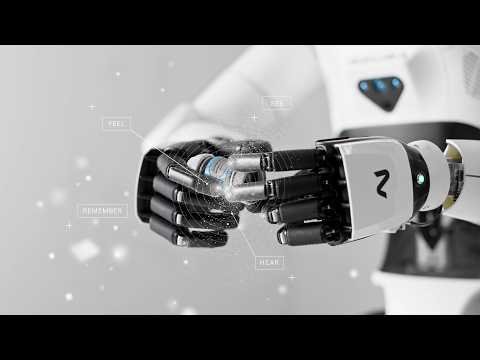
At its core, Neuron AI is a Perception-Language-Action (PLA) model, which is a technical way of saying it doesn’t just see the world; it experiences it. The model fuses data from 3D vision, tactile and force sensors, audio, and its own physical state into a single, cohesive understanding of its environment. Vision alone, Neura argues, is for amateurs. A truly useful robot needs to feel a screw catch, or hear the satisfying click of a connector locking into place—details that are invisible to a camera.
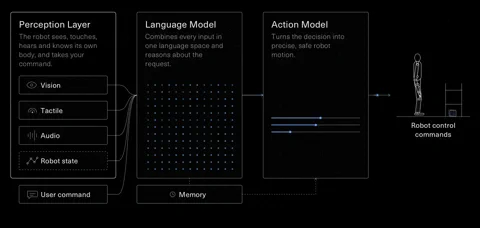
This synthetic brain is forged in what the company calls “NEURA Gyms,” where robots practice real-world tasks and learn from humans in sensor-equipped suits. The model also features a crucial memory layer, giving it a sense of object permanence—the profound understanding that an object still exists even when it’s out of sight. This allows the AI to perform complex, multi-step tasks without getting lost.
Why is this important?
Neura Robotics isn’t just building a clever model; it’s making a platform play. By designing Neuron AI to run across its five different robot embodiments and making it available for customer fine-tuning via its Neuraverse platform, the company is positioning itself as the potential “brain provider” for an entire ecosystem of hardware. This strategy directly challenges the vertically integrated approach of competitors who build bespoke AI for their own proprietary hardware.
With backing from industry heavyweights like Amazon, NVIDIA, and Qualcomm, Neura has the war chest to pursue this ambitious vision. The goal is to drastically reduce the “time-to-skill”—how quickly a robot can master a new task—and enable customers to deploy new capabilities across entire fleets almost instantly. While others build single-purpose machines, Neura is betting that a universal, multimodal brain is the key to finally scaling physical AI.