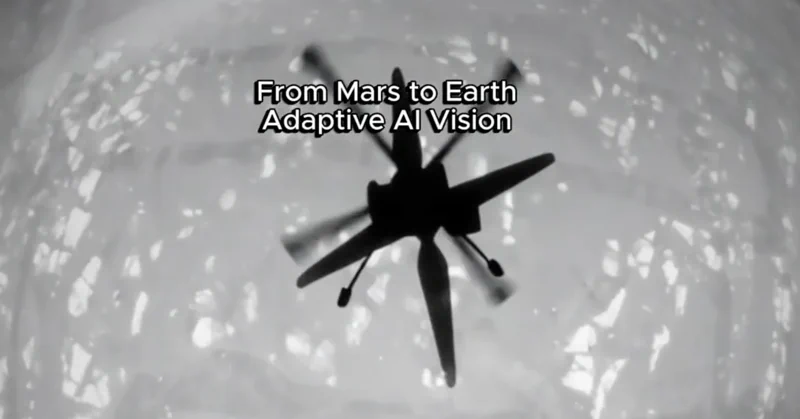
AstraQua, the startup led by Loay Elbasyouni—a lead electrical engineer behind the history-making Ingenuity Mars Helicopter—has secured a $1,274,990 Phase II contract from NASA. The objective isn’t to give your Roomba an existential crisis, but to teach machines a form of self-preservation the company calls “operational self-awareness.”
The technology, named AstraSense, is designed to move far beyond a simple “check engine” light. Instead of just flagging a binary fault, it allows a system to diagnose its own hardware degradation in real-time and reason about what it can still safely accomplish. It’s the machine equivalent of knowing you have a sprained ankle and choosing to walk carefully instead of attempting a sprint. As CEO Loay Elbasyouni puts it, “A robot should know when to slow down, not just when it has broken down.”
This NASA Small Business Innovation Research (SBIR) contract will initially focus the technology on electric and hybrid-electric aircraft propulsion, a critical component of the agency’s Advanced Air Mobility (AAM) goals. For autonomous flying taxis to become a viable reality, they need an almost paranoid level of reliability. A system that can intelligently adapt to a failing component, rather than simply ceasing to function mid-air, is a fundamental requirement. This Phase II award builds on a successful Phase I that demonstrated the core diagnostic capabilities.
Why is this important?
This research tackles a core challenge of autonomy: moving from brittle automation to resilient, adaptable systems. Most current robots operate with rigid failure states where a single unexpected fault can halt an entire mission. AstraQua’s approach promises machines that can gracefully degrade, adjusting their plans based on a nuanced understanding of their own physical health. While NASA’s futuristic aircraft are the first stop, the implications for industrial robots, long-duration drones, and the next generation of planetary rovers are profound. It’s a foundational step toward building autonomous systems that we can actually trust when things inevitably start to go wrong.