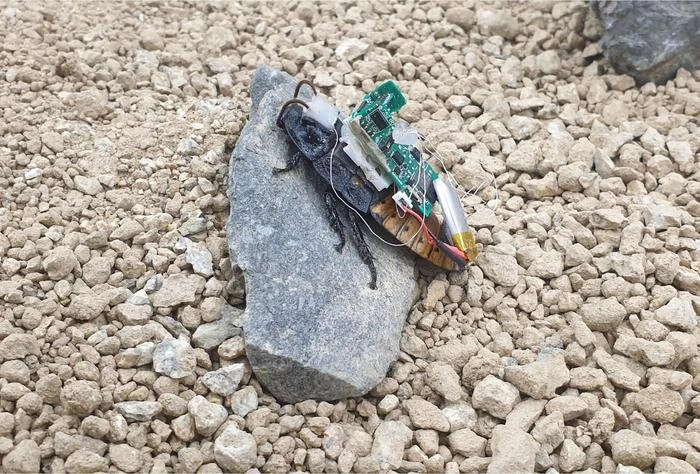
Just when you thought 2026 couldn’t get weirder, scientists have strapped AI-powered backpacks to living cockroaches, creating a biohybrid system that navigates complex terrain with unnerving efficiency. A joint research team from Osaka University in Japan and Universitas Diponegoro in Indonesia has developed what they call “biohybrid physical AI,” a system that wisely decides when to let the cockroach be a cockroach.
Published in the August 2026 issue of the journal Device, the research details a system that equips a live Madagascar hissing cockroach with a backpack containing sensors and a multilayer perceptron—a type of AI. This AI module processes data from onboard sensors to classify the surrounding terrain in real-time, distinguishing between flat surfaces, ascents, descents, and holes with a reported 92% accuracy. Previous cyborg insect systems would simply steer the creature around any obstacle, but this new AI is smart enough to know when the roach can handle it.
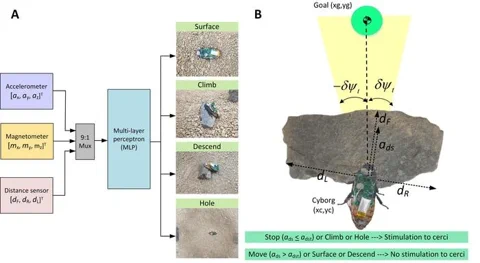
The key innovation is reactive climbing. When the AI recognizes the cockroach is beginning to climb an obstacle, it reduces the electrical steering stimulation. This allows the insect’s natural, evolved climbing abilities to take over, preventing the hesitation and inefficient movement caused by a controller that’s trying to micromanage. The result is a faster, more direct route across complex surfaces. The full details are available in their paper, titled “Biohybrid navigation through real-time terrain recognition and natural climbing in cyborg insect.”
Why is this important?
This isn’t just a high-tech science fair project. The goal is to create highly mobile, low-power agents for tasks like search-and-rescue operations in disaster sites, where tiny, resilient explorers are needed to navigate rubble and confined spaces. Instead of building a complex microrobot from scratch, this approach leverages millions of years of evolution and adds an AI co-pilot. As Professor Keisuke Morishima of Osaka University explains, the research could “inspire the development of robotic systems capable of operating in complex environments.” It marks a subtle but important shift from simply remote-controlling an organism to creating a cooperative system where artificial intelligence and natural instinct work together.