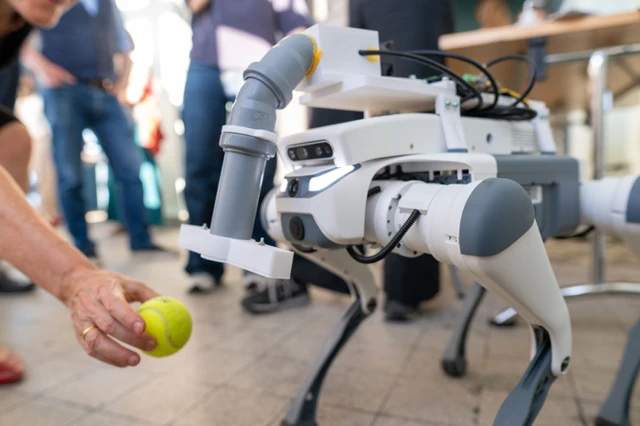
While the robotics world remains fixated on making robots that can see, walk, and talk, Deep Robotics is tackling a far more neglected, yet critical, sense: smell. At the “Future of Smell” exhibition hosted by Germany’s Dresden University of Technology, the company demonstrated a version of its Lite3 quadruped robot equipped with an intelligent electronic nose, effectively turning the machine into a high-tech sniffer dog for hazardous environments.
The souped-up Lite3 confidently navigated a cluttered exhibition space before stopping at a designated test point to take a “deep breath.” Its onboard e-nose system captured airborne odor signals, which were then rapidly analyzed by AI algorithms to identify specific chemical signatures. According to the company, the demonstration was a resounding success, with German researchers on-site reportedly exclaiming, “It really smelled it!” This transforms the robot from merely a “camera on legs” into a mobile sensory platform capable of detecting unseen dangers.
The solution integrates the electronic nose onto the agile Lite3 base, which can run for up to two hours, carry a 7.5 kg payload, and navigate 40-degree slopes. This mobility allows it to enter complex, high-risk areas inaccessible to humans for tasks like identifying gas leaks or locating sources of pollution.
Why is this important?
Adding olfaction to a robot’s sensory toolkit is a significant step for embodied AI, moving beyond passive observation to active environmental analysis. For industrial applications, this means a robot can autonomously patrol a factory floor and detect a faint gas leak before it becomes a catastrophe. In emergency rescue, it could identify the chemical signature of a trapped survivor. This fusion of mobility and an artificial sense of smell creates a closed-loop system of “mobility, perception, analysis, and early warning,” providing a safer and more efficient solution for environmental monitoring and industrial inspection than traditional static sensors. It’s a reminder that sometimes, the most important threats are the ones you can’t see.