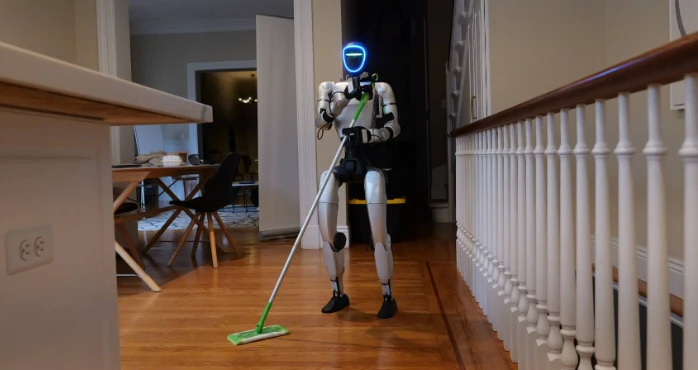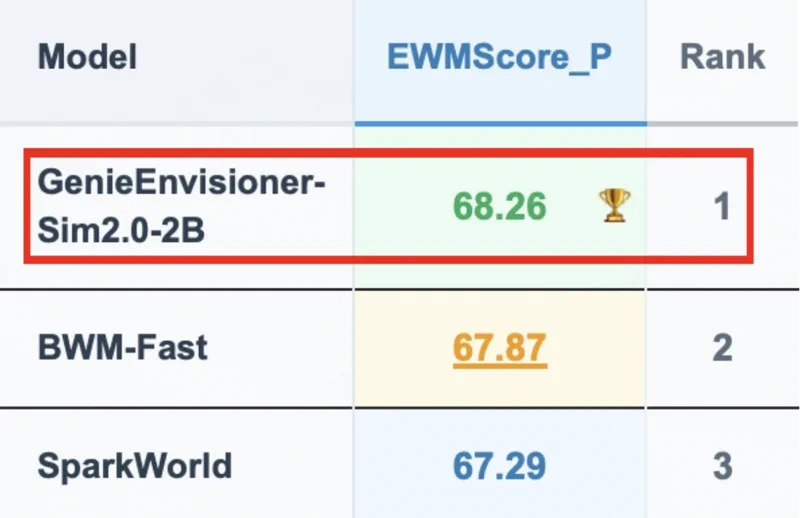
In a classic David-versus-Goliath scenario, but with more GPUs, a relatively tiny 2-billion-parameter world model from AGIBOT has just elbowed its way to the top of the WorldArena benchmark. The model, dubbed Genie Envisioner-Sim 2.0 (GE-Sim 2.0), is now ranked #1, staring down at massive generative video engines that have been hogging the spotlight. Turns out, making pretty videos is one thing; teaching a robot to not fumble a towel is another entirely.
This isn’t about generating the next viral cat video. GE-Sim 2.0 is a closed-loop physical simulator designed to be a boot camp for actual robots. The system demonstrates “High-Consistency Multi-View Generation,” ensuring what the robot’s head camera sees aligns perfectly with its wrist cameras—even when objects are in a blind spot or reflected in a mirror. It’s the kind of obsessive attention to detail that separates a useful simulation from a digital fever dream.
To make this actionable, AGIBOT tackled three massive simulation bottlenecks. First, a “Proprioceptive State Expert” decodes physical joint angles directly from the video, giving the robot crucial feedback to avoid drifting into mechanical chaos. Second, a “VLM-Based World Judge” acts as an automated referee, tirelessly scoring simulation runs so human engineers don’t have to. Finally, by using a distribution-matching distillation framework, they slashed inference time, rendering a complex 25-frame multi-view rollout in a brisk 2.3 seconds.
Why is this important?
Because it actually works in the real world. Physical robots trained using GE-Sim 2.0’s filtered synthetic data saw a massive 15% jump in real-world success rates on contact-rich tasks. This is a significant step in cracking the code for the embodied AI data bottleneck. While other models are focused on visual flair, AGIBOT is building actionable, physical world simulators that are making robots smarter, faster. The era of just looking real is over; the era of being real is here.
The project is open-source, and you can dive into the technical details yourself. Hyperlink: Check out the code on GitHub or read the full paper on arXiv.