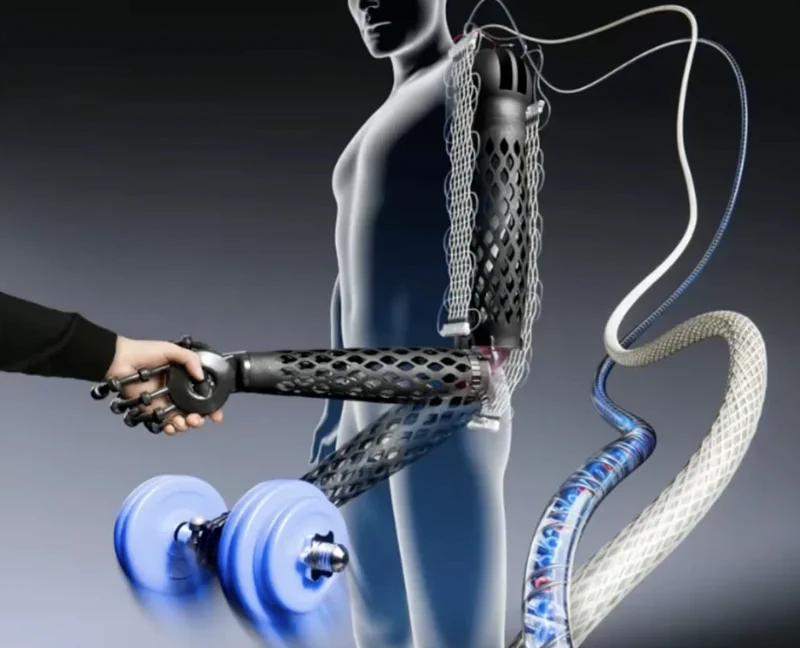
Researchers at the MIT Media Lab have developed a new class of artificial muscle fiber that makes traditional motors look like clumsy, prehistoric relics. In a recent interview, lead researcher Ozgun Kilic Afsar detailed how these “electrofluidic fiber muscles” operate, showcasing a 16-gram muscle bundle lifting a 4-kilogram weight—more than 250 times its own mass. The breakthrough, published in Science Robotics, ditches the need for bulky motors, noisy compressors, and external pumps, packing the entire actuation system into a silent, self-contained strand not much thicker than a toothpick.

For decades, robotics has been shackled to the “titans” of actuation: electromagnetic motors. While powerful, they represent a fragile, single point of failure. As Afsar explains, if a motor or its gearbox fails, the robot’s entire joint is paralyzed. In contrast, these new fibers mimic the hierarchical and distributed nature of biological muscle. Like the fibers in your bicep, if a few strands fail, the whole system degrades gracefully rather than failing catastrophically. The secret sauce is the integration of miniaturized electrohydrodynamic (EHD) pumps directly into the fiber, which use an electric field to move fluid and generate pressure without any moving parts.
We previously covered the initial announcement of this impressive technology, noting its potential for creating durable, even machine-washable, robotic textiles. You can get the backstory here: This Machine-Washable Muscle Fiber Can Lift 200x Its Own Weight . The recent interview with Afsar provides a much deeper dive into the mechanics and the philosophy behind moving away from rigid, joint-based actuation. Read the paper in Science Robotics.
Why is this important?
This isn’t just about making stronger, quieter robots; it’s about fundamentally changing how they’re built. Instead of designing a rigid skeleton and then figuring out how to bolt on clunky motors, engineers can now weave power and movement directly into the robot’s structure. This opens the door to truly soft, compliant machines that are safer for human interaction, as well as more advanced prosthetics and wearable exoskeletons. Imagine combining this with other futuristic manufacturing techniques, like those being developed by Allonics to weave complex robotic bodies: Allonic's $7.2M Bet to Weave Robot Bodies Like Muscle Tissue . We are looking at a future where a robot’s body and its muscles are one and the same—a resilient, silent, and unnervingly lifelike architecture.