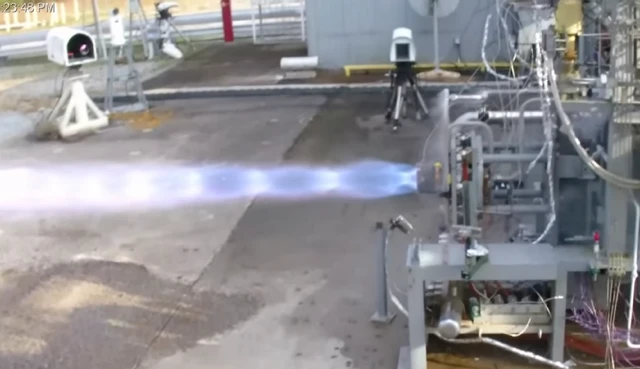
Pittsburgh, PA – In what can only be described as harnessing a continuous, controlled, supersonic explosion, Astrobotic today announced a landmark achievement in rocket propulsion. The company successfully tested its Chakram rotating detonation rocket engine (RDRE) at NASA’s Marshall Space Flight Center, where it produced over 4,000 pounds of thrust and, more impressively, completed a continuous 300-second burn. This five-minute hot fire is believed to be the longest duration ever for an RDRE, a technology that has long been the darling of propulsion theorists but a headache for practical engineers.
The test campaign, which took place in Huntsville, Alabama, saw two Chakram prototypes endure eight hot-fire tests, accumulating over 470 seconds of total runtime without the hardware showing any discernible damage. Unlike conventional rocket engines that rely on a steady burn, RDREs use supersonic detonation waves that continuously travel around a ring-shaped chamber. This method is theoretically more efficient, promising to extract more thrust from the same amount of fuel—a critical advantage when every gram counts in spaceflight.
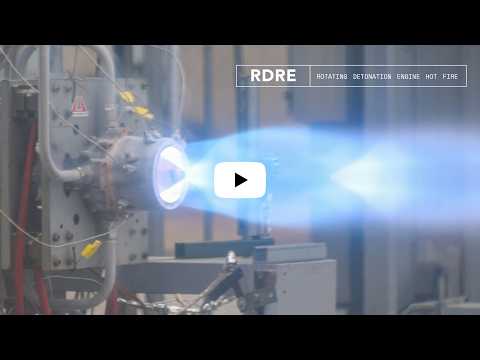
Astrobotic’s team proudly stated that the engine performed “even better than expected,” achieving a stable thermal steady state during its record-setting burn. This result is a significant step toward proving that RDREs can be reliable enough for actual missions, moving them from radical science projects to viable hardware. The company claims Chakram is now one of the most powerful RDREs ever demonstrated.
Why is this important?
A successful, long-duration RDRE test isn’t just a technical curiosity; it’s a potential paradigm shift for spacecraft design. The increased efficiency—potentially up to 15% better specific impulse—and smaller engine size could allow future spacecraft to carry more payload or travel further with less propellant. Astrobotic plans to integrate this technology into its future Griffin-class lunar landers, as well as its Xodiac and Xogdor-class reusable rockets. For a company that recently had a high-profile, if unsuccessful, lunar mission, proving out next-generation technology this decisively is a powerful statement. It signals that while getting to the Moon is hard, Astrobotic is dead serious about building the advanced, efficient hardware needed for a permanent cislunar presence.