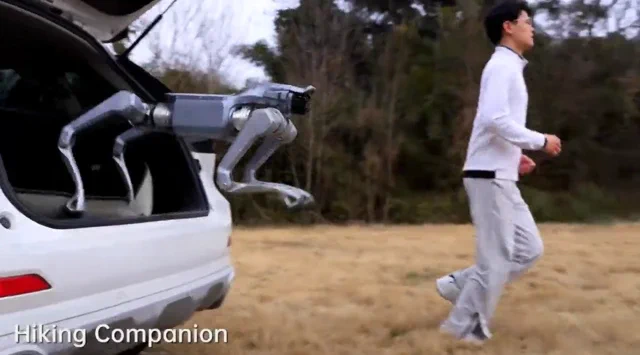
Unitree Robotics, a company that seemingly never sleeps, has casually unveiled its latest quadruped, the Unitree As2. Announced via a post on X, the new robot dog is being pitched as a “Companion” with “industrial capability,” and the specs suggest the latter is no exaggeration. The As2 boasts the ability to carry a hefty 15 kg (33 lbs) payload, run for over 4 hours without a load, and operate in the rain thanks to an IP54 ingress protection rating.
The numbers get more impressive from there. Unitree claims the As2 has a maximum joint torque of 90N·m and a range that exceeds 13 km (over 8 miles). The company is also emphasizing its “open secondary development,” a clear signal that it wants developers and commercial clients to treat the As2 as a customizable platform for serious applications, not just a high-tech pet. This combination of strength, endurance, and ruggedness puts it in direct competition with more established industrial players.
Why is this important?
Unitree continues its strategy of aggressively packing high-end features into its robots, a trend seen across its product line from the consumer-focused Go series to its H1 humanoid. The As2’s 15 kg payload capacity is particularly noteworthy, as it slightly edges out the 14 kg payload of Boston Dynamics’ well-known Spot robot. By offering a durable, high-capacity quadruped that is presumably less expensive (pricing has not yet been announced), Unitree is further commoditizing the industrial robot dog market. A robot that can haul tools around a wet construction site for hours on end is no longer a sci-fi fantasy; it’s rapidly becoming an off-the-shelf reality.