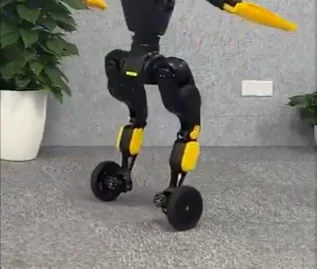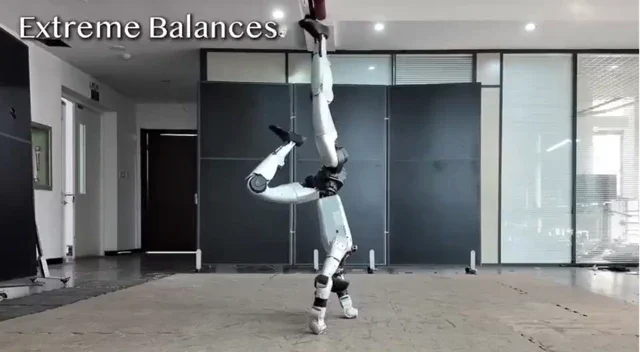
In a refreshing departure from perfectly choreographed but rigid routines, researchers have developed OmniXtreme, a general AI policy that allows a humanoid robot to pull off consecutive flips, balance in precarious positions, and even breakdance. This new capability, demonstrated on a Unitree Robotics G1 robot, moves beyond the “overfitted” policies often seen in flashy demos—like the impressive but single-purposed WuBOT performance at the 2026 Spring Festival Gala—into the realm of truly versatile athleticism.
The year-long project, a joint effort with Unitree, apparently came at a cost. The research team admits to burning through “dozens of G1 robots” to crack the code on general dynamic movement. Considering the G1’s entry-level price of around $13,500, that’s a significant hardware sacrifice to the gods of reinforcement learning. The team’s goal was to overcome the barrier that separates policies trained to track a specific motion and those that can handle the chaotic physics of extreme, real-world maneuvers.
The secret sauce is a two-stage training method. First, a flow-based generative control policy is pre-trained, giving the robot a foundational understanding of movement. Then, it undergoes post-training using “actuation-aware residual RL,” a critical step that fine-tunes the model to account for the complex dynamics and physical limitations of an actual robot. The researchers state this second stage was the key to successfully transferring the policy from simulation to reality. In a move that benefits the entire robotics community, the model checkpoints have been released on GitHub.
Why is this important?
The development of a single, unified policy for such a wide range of high-impact motions is a significant milestone. It signals a shift from creating robotic “specialists” that can only perform one spectacular trick to developing “generalists” with a broad repertoire of physical skills. By successfully bridging the notoriously difficult sim-to-real gap for extreme dynamics, OmniXtreme provides a viable framework for creating more robust, adaptable, and physically competent humanoid robots. Open-sourcing the models will likely accelerate research into creating the multi-talented robot gymnasts and dancers of the future.