Robot training is a tedious, soul-crushing grind of manual resets and constant supervision. For every successful action a robot learns, a human has likely reset the scene dozens of times after failures. A new framework called RoboClaw aims to end that nightmare by teaching robots the one skill they’ve been missing: how to clean up after themselves.
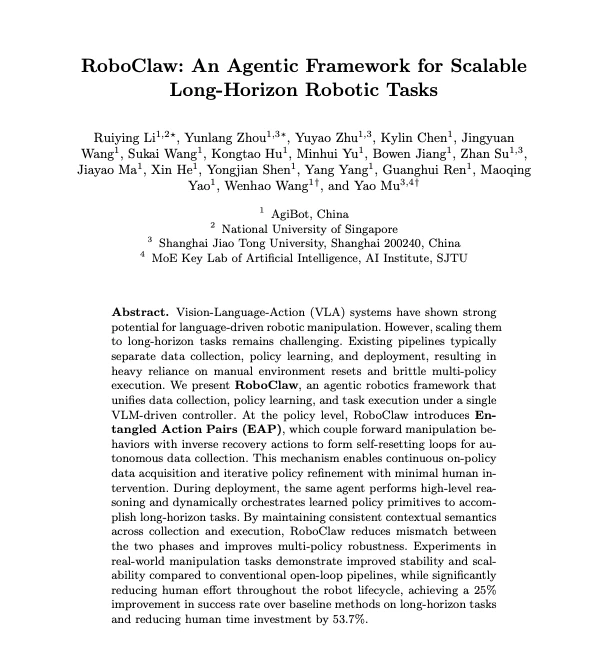
Developed by researchers from AgiBot, the National University of Singapore, and Shanghai Jiao Tong University, RoboClaw introduces a brutally simple and effective concept called Entangled Action Pairs (EAP). The core idea is that for every “forward” skill a robot learns—like placing lipstick into a holder—it also learns the inverse “undo” skill—taking the lipstick back out. These two behaviors create a self-resetting loop, allowing the robot to practice a task, reset the environment itself, and repeat, all while collecting data autonomously. No human babysitter required.
The results are, frankly, a little ridiculous. The researchers report an 8x reduction in human intervention during training, a 2.16x reduction in total human time needed per dataset, and a 25% higher success rate on complex, multi-step tasks compared to baseline models. The system was tested on a multi-stage vanity table organization task, where it autonomously learned to handle and place various items, recovering from its own errors along the way.
Why is this important?
The real breakthrough isn’t just the self-resetting loop. It’s that the same agent that trains the robot also deploys it. Most robotic systems use entirely separate, disconnected pipelines for data collection, model training, and real-world execution. RoboClaw unifies all three under a single Vision-Language-Model (VLM) driven controller.
This means when the robot fails at a real-world task, that failure is not just an error to be fixed by a human; it’s a new piece of training data that is fed directly back into the system. The robot learns from its own mistakes in the field, creating a closed-loop system that continuously improves over time. This shifts robotics from brittle, pre-programmed automation toward truly agentic systems that can learn and adapt in the wild.
Hyperlink: Read the full paper on arXiv