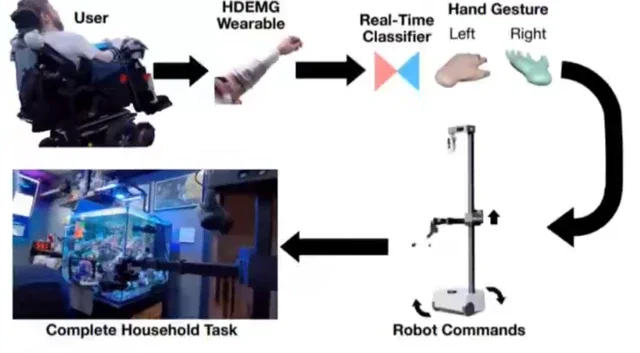
In a development that feels like it’s been pulled directly from a science fiction manuscript, researchers from Hello Robot Inc. and Carnegie Mellon University have demonstrated a system that grants quadriplegic individuals the ability to control a robotic assistant using their thoughts and residual muscle signals. A recent 12-day in-home study validated the system, allowing users to have the robot fetch water, grab food, and perform other daily tasks, all without invasive surgery.
The system employs two different non-invasive methods. The first uses high-density electromyography (EMG) to read the faint electrical signals in muscles, even those affected by paralysis. The second method involves a non-invasive electroencephalography (EEG) headset that interprets brain signals directly. During the study, users successfully commanded a Hello Robot Stretch mobile manipulator to pour drinks, retrieve clothes, and even remove a blanket. The Stretch robot, with its slender frame and telescoping arm, is specifically designed for navigating the organized chaos of a typical home.
Why is this important?
While brain-computer interfaces (BCIs) that require surgical implants, like those being developed by Neuralink Patient Controls a Virtual Hand With Thoughts Alone , often grab headlines, the real barrier to widespread adoption is the scalpel. This research demonstrates a powerful, non-invasive alternative that could be significantly more accessible and affordable. It represents a crucial step toward restoring autonomy for people with severe motor impairments.
The long-term vision is even more ambitious. If a simple EEG headset can control a mobile arm for household chores, the next logical step is to scale the interface to a full humanoid robot, as seen in other Mind-Controlled Humanoid Robot Turns Pages, No Brain Surgery Required . A person could theoretically navigate their entire day through a robotic proxy, handling everything from climbing stairs to grabbing a beer from the fridge. According to a research paper on the topic—which, with a publication date of 2602, seems to have arrived via a time machine—the potential is limitless. Read the paper on arXiv.