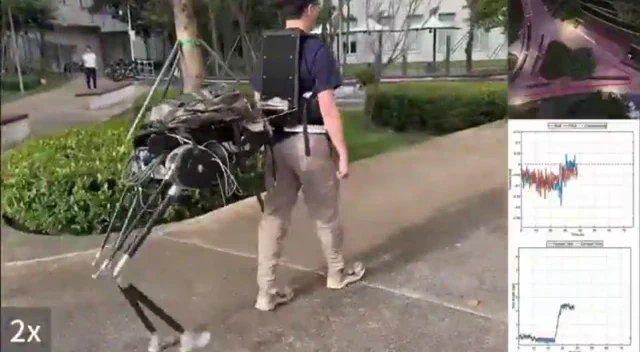
Just when you thought wearable robots were all about strapping yourself into a rigid metal suit, researchers at the Southern University of Science and Technology (SUSTech) have decided to give you a robotic hindquarters instead. No, this isn’t a joke; it’s a surprisingly effective new approach to helping humans carry heavy loads.
Led by Professor Chenglong Fu, the team developed a wearable “Centaur” system—a pair of independent robotic legs that attaches to your back. The goal isn’t to make you stronger, but to offload the work more intelligently. The device shoulders the vertical load, reducing the user’s net metabolic cost by a staggering 35% and slashing foot pressure by 52% when hauling a 20kg (about 44 lbs) pack.
Unlike traditional exoskeletons that run parallel to the user’s legs and can feel cumbersome, this quadrupedal setup works in series with the human. A specialized elastic coupling connects the robotic limbs to the wearer, staying stiff for quick movements but softening to absorb shocks. This “dynamics decoupling” allows the human to handle navigation and balance while the robot provides steady, load-bearing forward thrust. The design is surprisingly agile, capable of navigating tight figure-eight turns and handling stairs and uneven terrain.
Why is this important?
This research, published in the International Journal of Robotics Research, suggests the best way to augment human load-carrying isn’t to encase our limbs in metal, but to add new ones entirely. By separating the tasks—human for intellect, robot for grunt work—the centaur concept could pave the way for more efficient and less intrusive wearable systems in logistics, disaster relief, and any field where people have to carry heavy things for a living. It’s less Iron Man and more of a very practical mythological creature, ready to do the heavy lifting.