Swedish freight technology company Einride is quietly convincing some of the world’s largest brands to fire their truck drivers—or at least, the cabs they sit in. The company’s fleet of electric and autonomous trucks are now actively hauling goods for corporate giants like PepsiCo, Mars, and GE Appliances, signaling that the era of robotic logistics is not just coming, it’s already making deliveries.
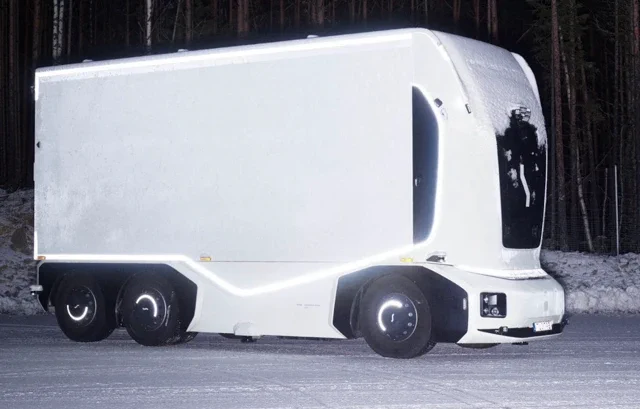
Einride’s approach combines a few different flavors of future-tech. Its most iconic vehicle, the cab-less Einride Pod, is a striking example of form following function; with no human driver to accommodate, the vehicle can dedicate its entire volume to cargo. These SAE Level 4 autonomous trucks are already operating on public roads in the US and Europe, monitored remotely by human operators. In a landmark move, an Einride vehicle completed the world’s first fully autonomous, cross-border delivery between Sweden and Norway in late 2025. For routes requiring more flexibility, the company also deploys fleets of conventional-looking (but fully electric) heavy-duty trucks, all managed by its AI-powered “Saga” logistics platform.
The partnerships are more than just pilot programs. With Mars, Einride is deploying a fleet of 300 electric trucks across Europe by 2030, aiming to cut 20,000 metric tons of CO2e annually. Its US operations with PepsiCo’s Frito-Lay are projected to cover nearly 200,000 miles a year, saving 143 metric tons of CO2e. The company claims its electric transport solutions can slash CO2 emissions by up to 95% compared to diesel, while remaining cost-competitive.
Why is this important?
While the tech world is fixated on humanoid robots and generative AI, Einride is tackling a less glamorous but critical sector: road freight, which accounts for a staggering 7% of global CO2 emissions. By integrating electric trucks, autonomous technology, and an AI-driven management platform, Einride is offering a full-stack “freight-as-a-service” model that actually works and is being adopted by risk-averse, blue-chip companies.
With a fresh $113 million in financing secured in February 2026 for a planned NYSE debut, Einride has the capital to expand its operations globally. Its success demonstrates a viable, scalable path to decarbonizing the supply chain—not in a distant, hypothetical future, but right now, on highways in Europe and the US. The biggest question is no longer if autonomous electric freight will take over, but how quickly the rest of the industry will be forced to adapt or be left in the diesel dust.