Researchers from the University of Cambridge and Japan’s National Institute of Advanced Industrial Science and Technology (AIST) have just published a paper that effectively teaches swarms of robots how to fly like caffeinated stunt pilots—without the subsequent mid-air collisions. The work, detailed in the March 19 edition of npj Robotics, introduces a framework for “kinodynamically aggressive maneuvers” among multiple agents. In layman’s terms, they’ve cracked a code for making groups of robots move very, very fast in tight spaces without a spectacular, expensive crunch.
The paper, titled “Concrete Multi-Agent Path Planning Enabling Kinodynamically Aggressive Maneuvers,” was announced by lead author Keisuke Okumura, a researcher at AIST and a visiting scholar at Cambridge. The core challenge in multi-agent pathfinding (MAPF) is that as you add more robots, the complexity of calculating collision-free paths explodes exponentially. This new “concrete planning” method cleverly blends continuous, real-world physics with a more manageable discrete search, allowing for rapid calculation of optimal paths for dozens of robots simultaneously.
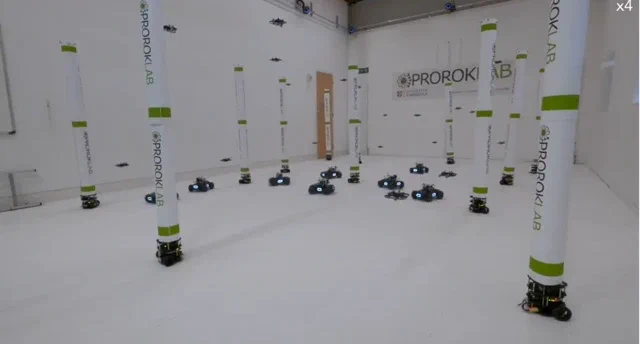
The term “kinodynamic” is key here; it means the planning accounts for not just the position of the robots (kinematics) but also the forces and momentum involved (dynamics). This is the difference between plotting dots on a map and planning a route for a fleet of speeding race cars that can’t exactly stop on a dime. The researchers validated the framework by deploying 40 robots—including 20 quadrotors and 8 ground robots—in a compact lab space, where they successfully executed complex, high-speed maneuvers.
Why is this important?
This research tackles a fundamental bottleneck holding back the true potential of swarm robotics. While current systems in warehouses or drone light shows are impressive, they often rely on simplified models, wide safety margins, and relatively sedate movements to avoid disaster. By creating a system that can plan for “aggressive” and tightly-coupled maneuvers in seconds, this work paves the way for far more dynamic and efficient applications.
Imagine warehouse robots that don’t just trundle along pre-defined routes but actively weave around each other at high speed to optimize fulfillment times. Think of search-and-rescue drone swarms that can rapidly and acrobatically navigate a collapsed building. This Cambridge-led research provides a foundational algorithm to turn those sci-fi scenarios into practical reality, moving multi-robot coordination from cautiously polite to brutally efficient.