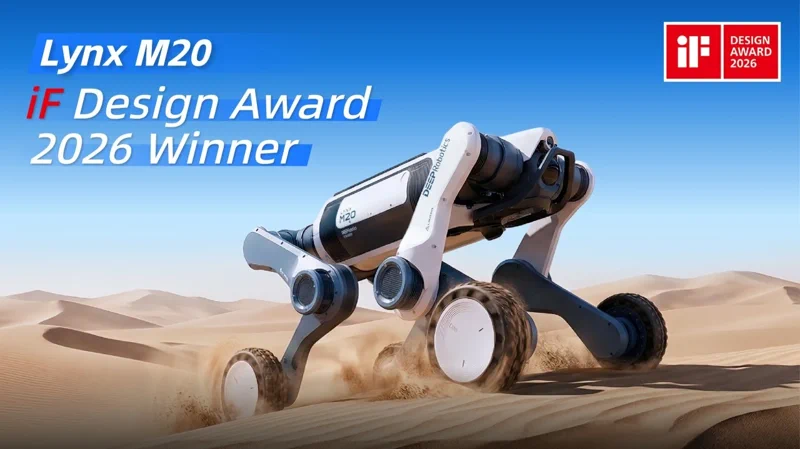
DEEP Robotics has officially been given a pat on the back by the design world, winning a 2026 German iF Design Award for its Lynx M20 wheeled-legged robot. The award, a prestigious German prize running since 1953, apparently found the M20’s blend of industrial chic and rugged practicality more compelling than tens of thousands of other entries. It’s another trophy for a robot that already boasts a CES 2026 Innovation Award, proving that even machines built for hazardous environments appreciate a little recognition.
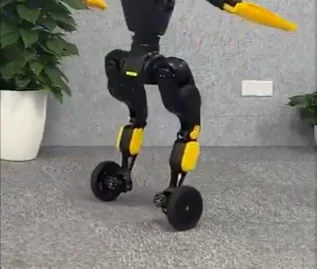
The core philosophy here is “form follows function,” which is a polite way of saying it’s built for work, not for show. The Lynx M20 features a symmetrical design for squeezing through tight spots and a “front elbow, rear knee” leg configuration that improves stability and compactness. Its key selling point is the hybrid wheel-leg system, allowing it to cruise at up to 5 m/s on wheels before switching to its legs to tackle tougher ground. Everything from the limbs to the main control unit is modular and features a quick-disassembly design, because nobody wants to call IT support in the middle of a muddy field.

This robot is designed to go where you wouldn’t. It boasts an IP66 rating, meaning it shrugs off dust, rain, and snow. With an operating temperature range of -20°C to 55°C (-4°F to 131°F) and the ability to carry a continuous payload of 15 kg, it’s built to haul gear in places humans can’t, or won’t. Hot-swappable batteries ensure it can work longer shifts than most interns, providing up to 2.5 hours of loaded runtime for continuous operation without a lengthy power nap.

While some robots are still figuring out how to open doors, the Lynx M20 is already gainfully employed. It’s been deployed in power substations, security patrols for public safety bureaus, and even served as a camera operator for the Chinese Super League finals—giving viewers the world’s first “robot dog’s perspective” of a professional sports broadcast. These real-world applications, from high-altitude supply runs in Hoh Xil to hauling crops in Chongqing, demonstrate it’s more than just a well-designed piece of hardware.

Why is this important?
This award isn’t just about a sleek design. It’s a validation that the most effective industrial robots are the ones where every design choice serves a practical, often grueling, purpose. The Lynx M20’s success highlights a larger trend: the maturation of embodied AI from lab experiments into reliable tools for industries like energy and public safety. The hybrid wheel-leg design is a direct answer to the industry’s need for a single platform that can move efficiently across large, paved facilities and then navigate the complex, uneven terrain right outside the factory door. For DEEP Robotics, it solidifies their position as a major player, proving that their focus on real-world problem-solving is getting noticed on a global scale. It’s a sign that the age of practical, versatile quadruped robots isn’t coming—it’s already here, and it’s inspecting a power grid near you.