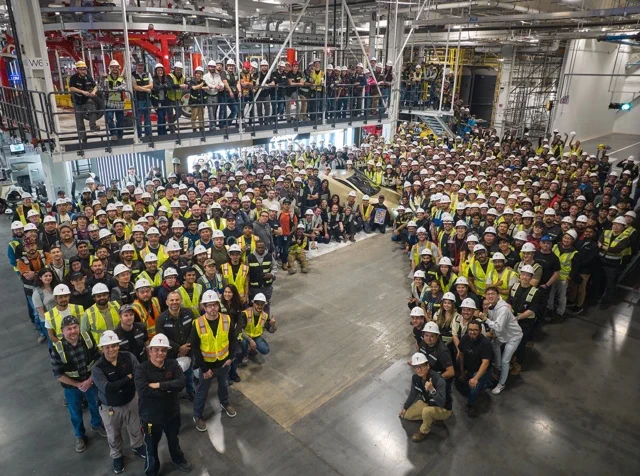
Tesla, Inc. has officially rolled its first production Cybercab off the assembly line at its Gigafactory in Austin, Texas. The company announced the milestone in a February 17, 2026, post on X, showcasing the futuristic, two-seater vehicle mobbed by the factory workers who built it. This marks the first tangible unit of a vehicle that has existed for years mostly in CEO Elon Musk’s ambitious timelines.
The Cybercab, also known as the Robotaxi, is Tesla’s purpose-built autonomous vehicle, famously designed without a steering wheel or pedals—a bold, and legally complicated, commitment to full autonomy. While Musk has repeatedly confirmed an April 2026 production start, he has also cautioned that the initial ramp-up will be “agonizingly slow” due to the vehicle’s entirely new design and manufacturing process.
This vehicle is the linchpin of Tesla’s plan to launch a massive autonomous ride-hailing network to compete with services like Uber and Lyft. The company already operates a small-scale “Robotaxi” service in Austin using supervised Model Ys, but the Cybercab is designed from the ground up for high-volume, low-cost production. Musk has stated an eventual goal of producing one vehicle every 10 seconds, targeting an annual capacity of 2 million units.
Why is this important?
The arrival of a production-intent Cybercab is a major statement in the autonomous vehicle race. While competitors like Waymo operate larger fleets—Waymo has around 2,500 vehicles to Tesla’s few hundred—they primarily retrofit existing car models. Tesla’s strategy is to mass-produce a cheaper, dedicated vehicle to achieve scale.
However, the road ahead is fraught with challenges. Tesla has yet to achieve true, unsupervised Level 5 autonomy, and its Full Self-Driving (FSD) beta remains a supervised system. Furthermore, federal regulations currently limit the number of vehicles that can operate without traditional driver controls on public roads. This first Cybercab is a significant manufacturing achievement, but it’s also the starting pistol for a much longer, more complex race against technology, regulation, and public trust.