In a move that should send a ripple of both excitement and panic through the robotics community, NVIDIA has open-sourced SONIC, a foundation model designed to finally make humanoid robots do something other than perform slick, pre-programmed acrobatics. The goal, as stated by NVIDIA researcher Yuke Zhu, is to pivot the industry’s “singular focus” from agile but preset motions to “putting generalist humanoids to do real work.” Let that sink in: real work.
SONIC, which stands for Supersizing mOtion tracking for Natural humanoId Control, is a “Behavior Foundation Model” for real-time, whole-body motion generation. It’s trained on a massive dataset of over 100 million frames of human motion capture data—that’s over 700 hours of people running, jumping, and crawling—to give robots a foundational understanding of natural movement without tedious, task-specific reward engineering. The system supports both direct remote control via teleoperation and inference from Vision-Language-Action (VLA) models, allowing a single, unified policy to control a robot.
Apparently, it’s not just theory. A beta-tester reported getting the system deployed in just a few hours, calling its performance “superior.” For a field accustomed to months of painstaking controller tuning, a setup time measured in hours is nothing short of miraculous.
Why is this important?
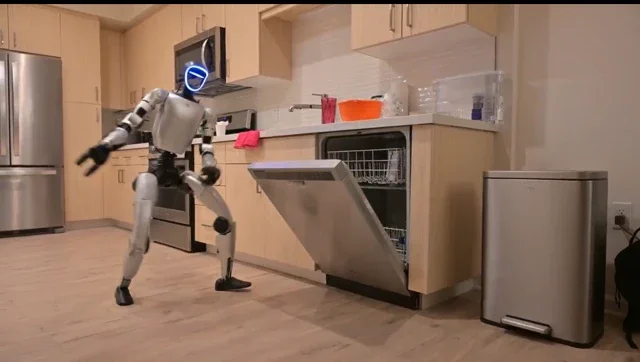
For years, the humanoid robotics field has been stuck in a demo loop, showcasing impressive but brittle feats of agility that rarely translate to practical applications. By open-sourcing a powerful, generalist controller, NVIDIA is effectively commoditizing the baseline for humanoid motion. This lowers the barrier to entry for startups and researchers, allowing them to focus on higher-level reasoning and task execution instead of reinventing the robotic wheel. It’s a strategic push, likely connected to NVIDIA’s broader Project GR00T (Generalist Robot 00 Technology), to create a standardized software and AI platform for the next generation of robots. The era of backflipping for clicks might finally be drawing to a close, replaced by the far more boring—and infinitely more valuable—era of robots that can actually do the dishes.