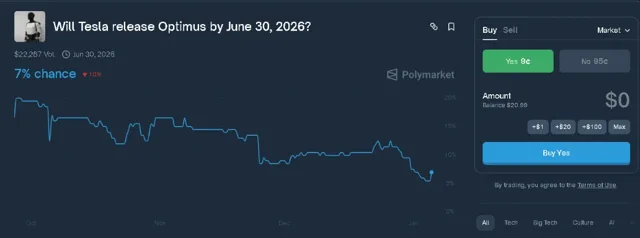
The smart money—or at least the money on prediction site Polymarket—is giving Tesla, Inc.’s Optimus humanoid a paltry 6% chance of being available for consumer purchase by June 30, 2026. The market’s rules are brutally specific: no internal factory deployments, no limited enterprise pilots, just a publicly available robot with a live checkout button. This sliver of confidence flies in the face of a manufacturing operation gearing up for war.
The hype reached a fever pitch in October 2025 with widespread rumors of a colossal $685 million order for linear actuators placed with Chinese supplier Sanhua Intelligent Controls—a deal supposedly large enough to build 180,000 robots. The news sent Sanhua’s stock soaring and suggested the robot’s V3 design was finalized and ready for mass production. There was just one tiny snag in that blockbuster story: Sanhua officially denied it, issuing a statement that it had no material information to disclose.
While that specific rumor was squashed, the underlying activity is real. In its Q3 2025 update, Tesla confirmed that the “first generation production lines for Optimus are being installed in anticipation of volume production.” CEO Elon Musk also teased the unveil of a “quite remarkable” Optimus V3 prototype for the first quarter of 2026, a machine he claims will look so real “you’ll need to poke it to tell it’s a robot.”
Why is this important?
The chasm between Tesla’s production ambitions and the market’s skepticism highlights the monumental difference between an industrial tool and a consumer product. While Musk hopes to have thousands of Optimus units working in his own factories, external customer deliveries aren’t expected until late 2026 at the earliest, and those will be for other businesses. A robot that can be sold to the general public requires a level of safety, reliability, and software polish that is orders of magnitude harder to achieve.
Furthermore, Tesla’s history of “production hell” and repeatedly delayed timelines for products like the Cybertruck and Full Self-Driving gives rational observers pause. Musk’s targets are astronomical—projecting an eventual capacity of 10 million units annually from Giga Texas—but more grounded forecasts suggest a few thousand units in 2026 is a more plausible scenario.
Meanwhile, the competition isn’t waiting. Chinese robotics firm UBTECH already has its Walker S industrial humanoids deployed on the assembly lines of automotive manufacturers. The company plans to scale production to 10,000 units annually by 2026, proving out the industrial use case while Optimus is still running drills inside Tesla’s walls. The prediction markets aren’t betting against Optimus eventually working in a factory; they’re betting it won’t be in your living room anytime soon. And given the track record, that seems like a pretty safe bet.