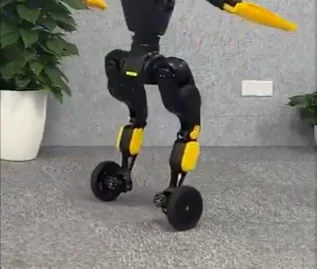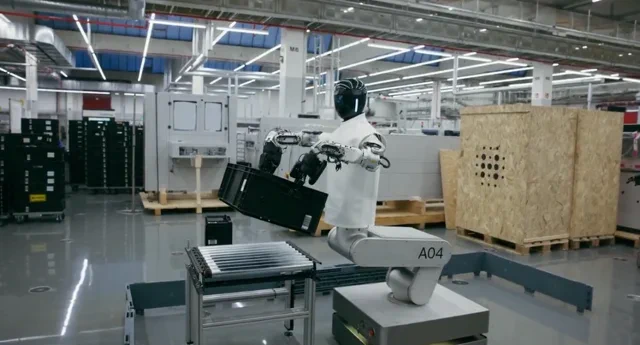
In the relentless march of robots from flashy demos to actual factory floors, UK-based Humanoid and German tech giant Siemens AG have just logged another milestone. The companies announced on January 15, 2026, the successful completion of a proof-of-concept (POC) that saw Humanoid’s HMND 01 wheeled Alpha robot deployed for a two-week stint in a live industrial environment at the Siemens Electronics Factory in Erlangen, Germany.
The robot wasn’t just rolling around looking important; it was put on tote-stacking duty. Specifically, the HMND 01 autonomously performed a “tote-to-conveyor destacking” task, which involved picking up totes from a storage stack, transporting them to a conveyor, and placing them at a designated pickup point for its human colleagues. The sequence was repeated until the stack was empty, proving the robot could handle the kind of repetitive logistics work that human spines have loathed for centuries. The successful POC is described as the first step in a broader partnership between the two companies.
Why is this important?
This trial is significant not because it’s the first time a humanoid has entered a factory—that’s becoming an increasingly common sight—but because it represents another crucial data point in the transition from R&D to ROI. Partnering with a manufacturing heavyweight like Siemens provides invaluable real-world validation for Humanoid’s platform. While bipedal robots often grab the headlines, this deployment of a wheeled humanoid underscores a pragmatic approach: solve real-world industrial problems now with the most effective form factor. Getting robots to reliably perform boring, repetitive tasks in complex, human-centric environments is the quiet, unglamorous work that actually moves the industry forward.