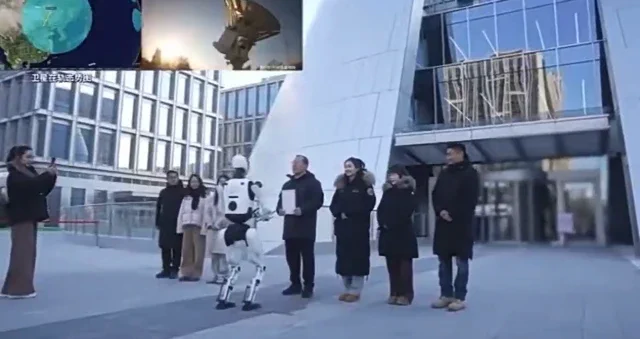
In a move that screams “the future is now, and it has no dead spots,” the Beijing Humanoid Robotics Innovation Center has successfully demonstrated its Tiangong humanoid robot performing a task while being controlled entirely via a low-orbit satellite link. This is reportedly the first time a humanoid robot has ditched terrestrial Wi-Fi and cellular networks to phone home from the field, proving that even our bipedal friends can work remotely.
During the demonstration, which took place at a recent commercial space industry event in Beijing, the Tiangong robot calmly retrieved a document from an autonomous WeRide Robotaxi. The entire operation, including the robot’s movements and a 720p live video feed from its perspective, was streamed in real-time to a command center through a GalaxySpace internet satellite hundreds of kilometers overhead. The test confirmed that complex, remote operations are possible without the safety net of ground-based communication infrastructure.
The Tiangong, a fully electric humanoid standing 163 cm tall, was unveiled in April 2024 and is capable of running at a stable 6 km/h. This latest achievement, however, isn’t about speed but about reach. By cutting the cord to ground networks, the robot is theoretically capable of operating anywhere on the planet with a clear view of the sky.
Why is this important?
This successful test is less about a single robot picking up a document and more about fundamentally redrawing the map for autonomous systems. The primary bottleneck for deploying advanced robots in the real world has been the reliance on stable, high-bandwidth communication. By routing control and data through a low-orbit satellite constellation, the Beijing Innovation Center has effectively erased “network blind spots.”
This opens the door for deploying humanoid robots in scenarios that were previously impractical or impossible: inspecting pipelines in remote deserts, assisting search and rescue in disaster zones where cell towers are down, or performing maintenance in offshore facilities and mines. It’s a critical step toward creating a world where robotic assistance isn’t confined to the pristine environments of a lab or factory floor, but can be deployed to the messy, unpredictable, and disconnected corners of the world where it’s needed most.