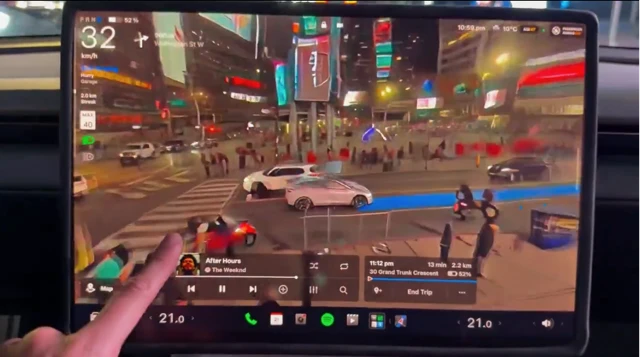
The internet briefly lost its collective mind this week over videos of Tesla’s latest Full Self-Driving (FSD) beta, and for once, it wasn’t about a car mistaking a stop sign for a suggestion. The new “reality view” visualizer paints a stunningly detailed, real-time 3D reconstruction of the world on the car’s main display. It’s so fluid and photorealistic that one observer declared, “ez sokkal durvább, mint a GTA VI” — “this is way more insane than GTA VI.” A bold claim, but watching a digital twin of your car navigate a rain-slicked, neon-lit city, you start to see their point.
But here’s the punchline: this gorgeous, computationally intensive graphics flex isn’t really for the car you’re driving. It’s a public-facing demo of the world-modeling technology Tesla is building for something far more ambitious. In a series of technical deep-dives, CEO Elon Musk pulled back the curtain, revealing not only how the visualizer works but also where the company’s true AI priorities lie. And spoiler alert, they walk on two legs.
Deconstructing the Digital Twin
According to Musk, the magic behind the curtain is a diffusion model, a class of generative AI famous for creating images from noise. Tesla’s system, however, is on a whole other level. The process starts with the Tesla Universal Vision Encoder (UVE), which processes the raw camera feeds. These UVE features are then forked. One stream feeds the main 3-billion parameter driving model—the actual FSD brain responsible for steering and speed.
The other stream goes to a separate, ~1-billion parameter diffusion model. This model’s job is to create the “reality view.” It takes the previously generated frame, adds a bit of digital noise, and then uses the latest UVE features to “denoise” it into the current, hyper-realistic view. The result is a short video chunk of 8 frames rendered at 36 fps, all running on what amounts to spare change in terms of computing power.
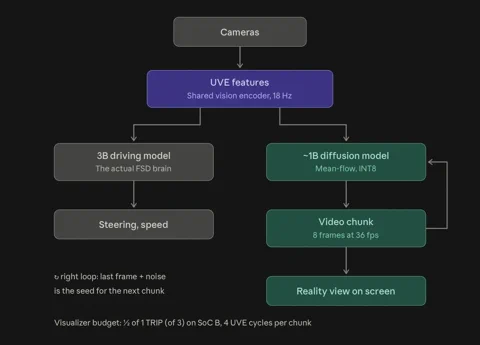
Musk detailed the brutal hardware constraints: this entire process runs on just half of one of the three TRIP (Tesla Inference Processor) engines on the car’s AI hardware, known as SoC B. He noted that the TRIP engine is an 8-bit integer-only processor that has to emulate floating-point operations like softmax in a painstaking 28 steps. That Tesla’s engineers squeezed a 1B-parameter diffusion model onto this silicon is, frankly, an act of pure computational wizardry or sheer stubbornness.
The Real Goal: A “Pixel-Perfect” World Model
So why bother? Why dedicate precious compute resources to making a pretty picture when FSD still occasionally treats cyclists like optional obstacles? The answer is synthetic data generation. Musk stated that Tesla has had a “~pixel-perfect world model since last year.” This visualizer is the first real glimpse of that model in action.
A perfect simulation of reality is the holy grail for training autonomous systems. Instead of needing to drive millions more miles to encounter rare edge cases, Tesla can generate infinite variations of scenarios within its simulation. It can create virtual blizzards in July, test responses to rogue kangaroos in downtown Manhattan, and generally torture-test its driving AI in ways that are impractical or unsafe in the real world. The pretty pictures in the car are just a byproduct; the real product is the data factory.
The AI5 Bombshell: Not For You, Driver
Just as everyone was digesting the technical feat, Musk dropped the other shoe. When asked about future hardware improvements, he revealed that the next generation of Tesla’s custom AI silicon, AI5, will be a “gigantic improvement” with roughly 12 times more compute. Then came the twist.
“It’s going to Optimus. Cars will remain at AI4. That’s enough to solve superhuman driving.”
This single statement reshuffles Tesla’s entire narrative. The company is publicly claiming that its current AI4 hardware is sufficient to achieve “superhuman” self-driving—a claim that will surely be met with a healthy dose of skepticism from anyone who has used the system. The real headline is that the company’s most advanced AI chip, with an order-of-magnitude leap in performance, is being exclusively funneled into its humanoid robot program.
The implication is clear: Tesla sees embodied, general-purpose robotics as a much harder, and ultimately more valuable, problem to solve than autonomous driving. A car operates in a structured, rule-based environment (lanes, signs, traffic laws). A humanoid robot must navigate the chaotic, infinitely variable mess of human spaces. It needs vastly more computational power to build a world model that can understand not just how to drive on a road, but how to open a door, operate a coffee machine, and fold laundry without setting the house on fire.
While Tesla owners get a fancy new screen saver that looks like a video game, the real next-generation AI is being built for a bipedal robot. The world model powering this stunning visualizer is just the training ground. The true test will be when that same understanding of the physical world is deployed not on four wheels, but on two legs, powered by an AI chip that makes the one in your car look like a pocket calculator.