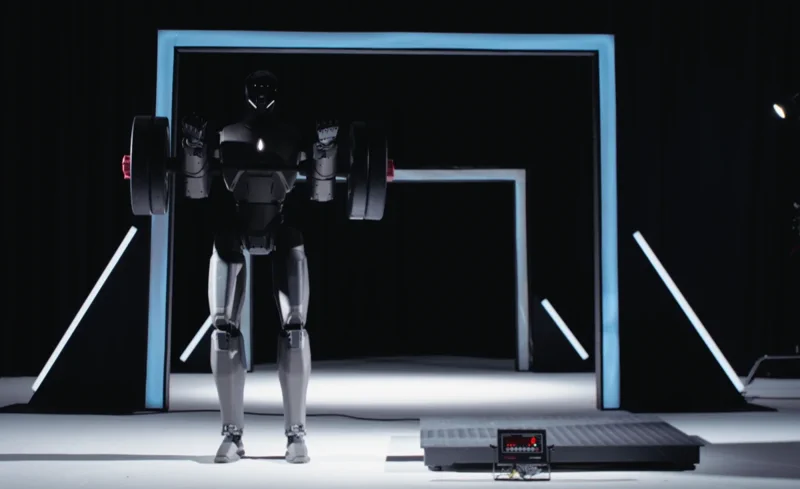
While the rest of the robotics industry remains locked in an unspoken arms race to see whose multi-million-dollar biped can fold a t-shirt the least awkwardly or gingerly balance a latte, San Francisco-based Foundation Future Industries has decided to take the opposite route: unapologetic, heavy-duty brute force.
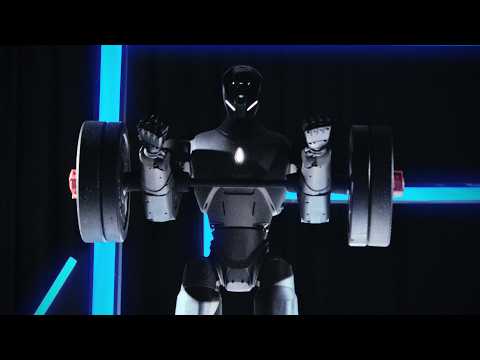
Enter the Phantom Mk2, a six-foot-tall, 185-pound humanoid robot designed not for cozy domestic living rooms, but for the grit, mud, and hazards of heavy industry and combat zones. While most commercial humanoids top out at carrying modest payloads of 20 to 40 pounds, the Phantom Mk2 claims a staggering 200-pound (90 kg) close-carry payload while actively walking. In pure power-to-weight terms, this machine is engineered to shoulder more than its own physical body weight, throwing down an aggressive gauntlet against the dainty chore-bots dominating venture pitch decks.
The Anti-Barista: Engineering for Mud, Dust, and Heavy Loads
Foundation CEO Sankaet Pathak has never minced words about the company’s design philosophy. The goal was never to manufacture an uncanny “robotic person” with existential ambitions, but to forge an industrial tool that performs brutal, dangerous tasks without complaint. That mandate dictated a clean-sheet mechanical overhaul for the Mk2.
Standing 6 feet (183 cm) tall and tipping the scales at roughly 185 to 195 pounds depending on configuration, the Phantom Mk2 sports 29 degrees of freedom driven by custom high-torque cycloid actuators and field-swappable modular joints. Unlike delicate showroom prototypes that panic at the sight of a puddle, the Mk2 is built with full IP67 dust and water resistance. The robot is engineered to operate in blinding rain, desert dust, sub-zero snow, and blistering heat.
Powering this heavyweight frame is an onboard 3 kWh battery system engineered for a 4 to 6 hour operational runtime under typical workloads. Crucially for continuous three-shift factory operations, the battery architecture supports a rapid 30-minute fast recharge, minimizing downtime in settings where every idle minute bleeds capital.
Cortex II AI: Teaching Muscle Memory in Weeks, Not Months
A rugged mechanical chassis without sophisticated spatial awareness is just an expensive pile of scrap metal waiting to punch through drywall. To drive the Phantom hardware, Foundation unveiled its second-generation embodied AI system: Cortex II.
Rather than relying on brittle, hand-crafted inverse kinematics or spending months tuning simulator models, Cortex II acquires real-world manipulation skills primarily through human imitation learning. Foundation claims the system can ingest human behavioral demonstrations, model the physical constraints, and deploy a brand-new industrial skill in less than two weeks. In targeted manipulation routines, the company reports Cortex II can master complex tasks with as few as 60 human demonstrations, marching steadily toward single-shot task ingestion.
The underlying intelligence relies on a dual-engine architecture:
- Reasoning Model: Interprets high-level operational commands in natural language, deconstructing abstract goals into logical, physical sub-goals.
- Embodied World Model: Trained on vast video corpora and real-world physical interactions (including unstructured sensory free-play), predicting environmental dynamics and force reactions to ensure stable locomotion and grip control.
To run these models on the edge without tethering the bot to a cloud server, Foundation partnered with AMD to integrate the Ryzen AI Embedded X100 platform directly into the torso. Combining “Zen 5” CPU compute, RDNA 3.5 graphics, and dedicated XDNA 2 neural processing units (NPUs) over unified low-latency memory, the architecture ensures that perception, dynamic balance, and path generation do not choke the robot’s thermal or power envelope.
From Factory Assembly Cells to Frontline Logistics
Foundation’s trajectory has differed sharply from standard Silicon Valley playbooks. The company’s earliest iteration, the Phantom Zero, was little more than a pair of actuators and an armless torso. Yet Foundation promptly bolted it inside an active automotive manufacturing cell, running three shifts a day, five days a week. According to company disclosures, Phantom variants participated in the assembly workflows of more than 24,000 vehicles during extended operational trials.
However, the company’s most controversial and ambitious moves belong in defense. Foundation previously deployed two Phantom MK1 units to Ukraine to evaluate robotic utility in non-combat battlefield logistics, tactical resupply, and hazardous reconnaissance. The brutally unforgiving conditions of the field revealed critical hardware vulnerabilities, leading directly to the Mk2’s sealed joints, fall-recovery routines, and double-strength load ratings.
While competitors sign strict pacifist pledges barring their machines from security deployments, Foundation has leaned hard in the opposite direction. The startup has openly explored defense applications ranging from military tunnel inspection to forward-operating base logistics, maintaining that removing flesh-and-blood personnel from lethal corridors is the ultimate humanitarian objective.
Reality Check: Scaling Past the Silicon Valley Hype
Impressive reveal videos and bench-press demos on a studio stage are standard robotics fare, but the real test is commercial economics. Foundation previously signaled that commercial units of its earlier generation carried an annual lease cost around $100,000 per robot per year. For heavy industries juggling acute labor shortages and hazardous duty liabilities, that figure can easily pencil out—provided the hardware survives round-the-clock abuse without blowing an actuator every forty-eight hours.
Achieving scale, however, requires serious cash reserves. With strategic expansion advisors like Eric Trump on board and South Korea’s Base Group exploring a reported $150 million investment alongside a planned manufacturing joint venture in East Asia, Foundation is aggressively positioning itself for global manufacturing. The company has slated early production for 2027, eyeing an initial capacity of 5,000 robots annually before ramping toward tens of thousands.
Whether Foundation can successfully transition from arresting hardware demos to mass-producing battle-hardened industrial bipeds remains to be seen. But in an industry crowded with robots that look ready for an art gallery, the Phantom Mk2 is a loud, 200-pound reminder that real value in robotics often comes covered in hydraulic grease, dust, and sheet metal.