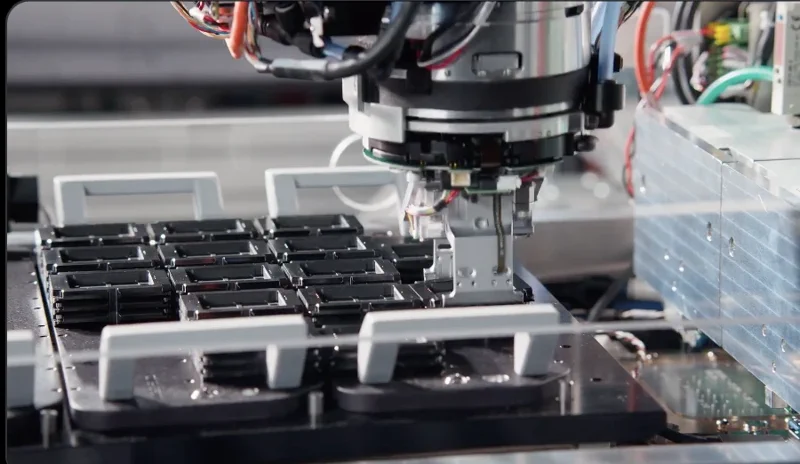
Atomic Machines wants manufacturing to work more like software: describe a device digitally, then build it without developing a new factory process for every design. The company introduced its Matter Compiler in October after six years in stealth. Its first disclosed product, the PrimeSwitch PS-150 power relay, gives that ambitious pitch a component you can actually put on a circuit board.
The distinction matters. A programmable shape is useful; a working machine also needs moving parts, suitable materials and predictable physical behaviour. According to Atomic Machines’ description of the Matter Compiler, its manufacturing platform brings those capabilities into a reusable digital process. A new device should require different instructions rather than a new set of masks or product-specific tooling. That is a substantial promise for an industry where the process can become as bespoke as the product.
An AI loop with something physical to measure
Founder Jeff Holden frames the project as a bridge between digital design and the physical world. In the company’s account of its approach, generative design depends on a manufacturing system that can execute granular operations and return feedback about the result. Making a plausible CAD model is only the opening move; the material still has to cooperate.
The Matter Compiler is intended to build, measure and carry what it learns into later designs. The longer-term goal is a complete prompt-to-product workflow. That remains a goal, rather than evidence that an arbitrary written request can already be turned into any finished machine. Engineering validation, material behaviour and repeatable production are still the tests that matter.

Why start with a power relay?
The first demonstration is the PrimeSwitch PS-150, an electromechanical relay. Conventional mechanical contacts conduct efficiently but take time to open. Semiconductor switches can react quickly, with their own conduction losses and isolation considerations. Atomic Machines is targeting a combination of fast opening, low resistance and physical separation of the contacts.
The manufacturer’s published PrimeSwitch specifications list:
- 150 A continuous AC or DC current, without active cooling.
- 200 micro-ohms on-resistance.
- 50 microseconds opening time to 1,500 V galvanic isolation.
- 9.5 mm diameter by 3 mm dimensions, in a surface-mount package.
- Bistable operation, so holding either state requires no holding power.
These are manufacturer specifications, not independent test results. The product page currently lists sampling availability. That is a useful proof point, but it is a different milestone from widespread deployment or demonstrated mass-production economics.
A manufacturing platform still has to prove it can generalise
PrimeSwitch is significant because it connects an unusual manufacturing process to a recognisable engineering requirement. The broader proposition is that the same platform could create other classes of micro-machines, extending beyond a single electrical component into mechanical, fluidic or optical devices.
The next useful evidence would be materially different devices built on the same platform, together with production yield, reliability and throughput data. A fast relay is a concrete start. A general-purpose factory for micro-machines is the larger claim, and the distance between those two deserves attention even when the marketing is excellent.