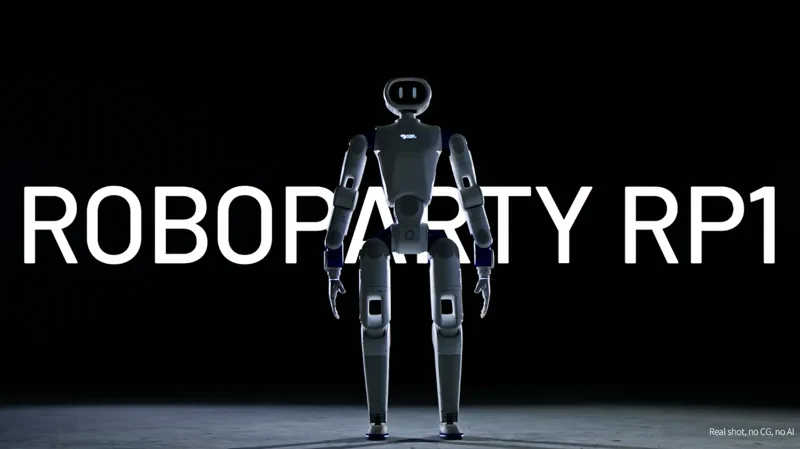
Just when you thought the humanoid robot market couldn’t get more crowded, another contender steps into the ring. But this one’s different. This one brought a philosophical manifesto along with its spec sheet. Meet the RoboParty RP1, a humanoid that wants to tear down the industry’s walled gardens with a promise so audacious it feels like a dare: “full-stack open-source.”
In an era where the most advanced robots are often impenetrable black boxes, Shanghai-based startup RoboParty is betting that the future of embodied AI shouldn’t be dictated by a select few. The RP1, also known as ROBOTO 01, isn’t just a product; it’s an invitation for every researcher and developer to look under the hood, tinker with the engine, and maybe even redesign the transmission. The company’s goal, in its own words, is to become the “Android of robotics”—a completely open platform to accelerate everything.
No Black Boxes Allowed
The term “open source” gets thrown around a lot, often meaning little more than a public-facing API or SDK. RoboParty is taking it to the extreme. They are opening up the entire development stack, from mechanical CAD files, electronics schematics, and bill of materials to the firmware, motor controllers, simulation tools, and their own PartyOS embodied AI system.
This means researchers aren’t just getting a robot; they’re getting the blueprints. If a motion error occurs, they can trace it from the high-level AI policy right down to the voltage on an actuator. This level of transparency is a direct response to a major frustration in the research community: being locked out of the core systems of the very machines they’re trying to advance.
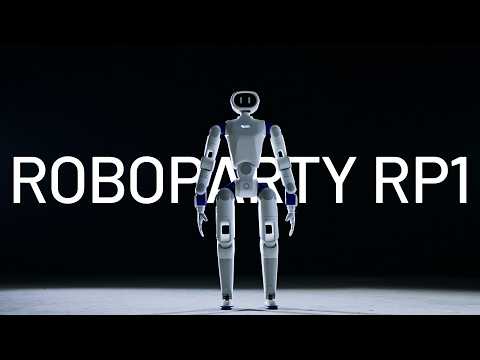
The hardware itself is built for the rigors of a lab. The standard version stands 1.3 meters tall with 24 degrees of freedom, designed for locomotion and balance research. A “Pro” version bumps that to 30 DoF for more complex manipulation and human-robot interaction studies. It boasts a 2-3 hour battery life with hot-swappable batteries, 240W USB-C fast charging, and the ability to operate while plugged in—small details that are huge quality-of-life improvements for anyone running long experiments.
Under the Hood: More Than Just Parts
Diving deeper, the RP1’s design philosophy is all about modularity and real-world utility. The robot uses in-house developed ROMOMO high-torque joint modules, and RoboParty gives developers low-level access to control them directly. This is a critical feature for anyone working on novel locomotion or manipulation algorithms, as they aren’t forced to work around a manufacturer’s pre-canned control schemes.

The robot features interchangeable heads for different sensor payloads and swappable hands, allowing a single platform to be adapted for a wide range of experiments. This isn’t just a walking chassis; it’s a configurable scientific instrument. And it’s already capable of foundational motor skills like continuous walking, recovering from a shove (as seen in their delightful “Kick Me” demo at IROS), and getting up after a fall, providing a stable base for developers to build upon.
A Party Favor for the Open-Source Community
RoboParty isn’t the first to the open-source humanoid block party. Academic projects like UCLA’s soccer-playing ARTEMIS have been championing the cause for years. UCLA Open-Sources Soccer-Playing Artemis Humanoid More recently, we’ve seen a rise in more accessible kits aimed at builders, like the impressively affordable Asimov-1, the so-called “IKEA humanoid.” Asimov 1: The $20,000 IKEA Humanoid for Robot Builders
The RP1, however, carves out a unique niche. It’s not a DIY kit for hobbyists but a high-performance, research-grade platform that happens to be completely open. The company has already garnered a significant following, with its earlier RPO project getting over 2,600 stars on GitHub. The complete plans and code for RP1 are also being published on the company’s Hyperlink: GitHub.
While RoboParty hasn’t announced a price, the focus on providing a foundational tool for labs and universities suggests it’s aiming to empower the next wave of robotics innovation, not just sell a product. By providing a common, transparent hardware and software platform, they are inviting the global research community to collaborate, build upon each other’s work, and accelerate the arrival of truly intelligent machines. The party is just getting started, and everyone’s invited.