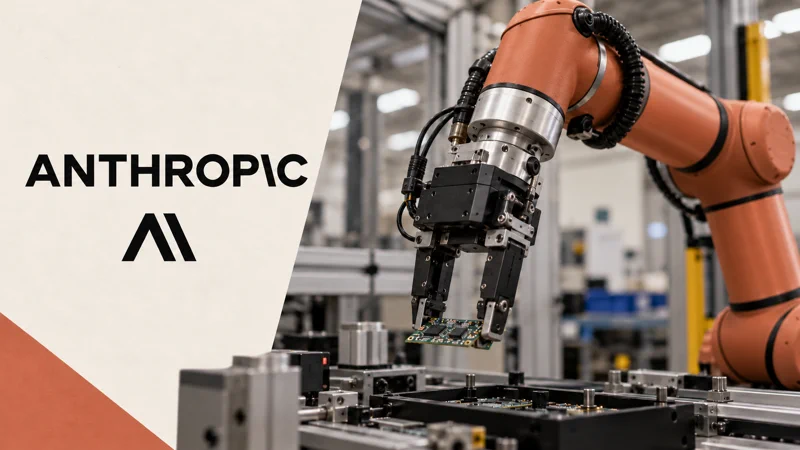
Anthropic’s IPO filing, submitted on October 26, 2026, identifies robotics and physical work as growth areas. The developer of Claude plans to connect AI agents with programmable devices in labs and factories through the Model Hardware Standard (MHS). (SEC: Filing Details)
An IPO prospectus is rarely the genre one chooses over a compelling robot video. It features no backflipping humanoids, and the risk factors section typically doesn’t draw a stadium-sized audience. Yet, buried within Anthropic’s papers is a more intriguing story than just the future price of a share: one of the leading chatbot developers sees business in operating machines.
What’s more, this doesn’t necessarily require building their own robots. The twist is that a common software layer could sit atop existing robotic arms, microscopes, and lab equipment. The robotics industry has long been adept at manufacturing robust arms. However, integrating machines from different manufacturers often still feels like setting up a home printer — except here, it’s not just your weekend, but the entire production schedule that could go awry.
What Does the IPO Filing Actually Say?
Anthropic discusses robotics, advanced manufacturing, and logistics as new market opportunities. The section outlining their growth strategy specifically names expansion into the physical world; examples for MHS include microscopes, liquid handling equipment, and commercially available robotic arms. The relevant sections can be found on printed pages 186, 198, and 202 of the document. (Anthropic Form S-1)
This is a statement of strategic intent. It doesn’t yet indicate how many factories will pay for it, or when it will become a significant revenue stream. The submission of the S-1 itself does not signify the completion of the IPO.
In RoboHorizon’s interpretation, the crucial shift lies in the task’s boundary: AI’s work can continue beyond a written instruction. An experiment must actually be initiated, its results measured, and the next step chosen based on those findings. Alongside the elegant answer comes the responsibility for execution.
Image: AI-generated editorial illustration. The robotic arm is a concept illustration, not an announced Anthropic hardware product.
What is MHS, and How Does it Relate to MCP?
The Model Hardware Standard aims for a common description and access method for devices. According to Anthropic’s August 27, 2026 presentation, the standard driver makes equipment discoverable, exposes its operations, and provides information about its capabilities, characteristics, and operational limits. Basic operations include simple read and write commands. (Anthropic Technical Presentation)
The Model Context Protocol (MCP) is one access pathway; MHS can also be used via command line and program code. The solution is model-agnostic: the goal is a hardware connection layer usable with various AI agents.
Imagine a workstation where a robotic arm transfers a sample plate to a measuring instrument. The task doesn’t end with the arm simply being able to move. It needs to know when it’s safe to grasp the plate, if the receiving equipment is ready, whether the measurement is complete, and what to do if any step gets stuck. A common interface can be valuable in this multi-actor coordination.
However, a hardware standard alone doesn’t teach AI physics. Device availability, movement quality, and overall system safety are separate problems to solve. Just because every instrument connects to the same conductor doesn’t mean the orchestra doesn’t still need rehearsal.
Who’s Already Testing This on Robots?
Doosan Robotics has confirmed its participation in the research program; Anthropic mentions quality control and multi-robot coordination tests. Hugging Face, according to Anthropic’s announcement, is working on MHS support for its LeRobot robotics library. The tense of these verbs matters: testing and development are not yet generally available products. (Doosan Robotics, Anthropic)
Universal Robots presented a more detailed, documented experiment on August 28. According to the company, a Claude-based agent discovered four cobots via the PolyScope X platform and coordinated their applications, including workpiece handovers. The company explicitly describes the demonstration as a proof-of-concept. (Universal Robots: The Four-Cobot Experiment)
Equally crucial is the control architecture: Universal Robots states that its own safety architecture remained the foundation, while MHS makes device-provided limits, interlocks, and emergency stops interpretable by the agent. This approach had not yet been tested on mobile robots at that time.
This is where the story begins to outgrow a single clever robotic arm. For a factory, the collaborative cell is the meaningful unit: one machine feeds, another grasps, a third measures. If only one of these can perform a spectacular demo, the other two remain paid spectators.
Why Is a Laser Fault More Interesting Than Another Robot Demo?
QuEra Computing’s experiment provides a tangible example of how AI-driven research can evolve into conventional automation. The company worked with Claude, as part of the MHS research program, on maintaining a quantum computer’s laser system at a precise frequency and recovering from errors. (QuEra: Detailed Experiment Results)
According to QuEra, the developed controller restored the system in 695 out of 700 timed trials across seven error types. This is the frequently cited 99.3 percent. Most errors were resolved within six seconds; more challenging cases required approximately 10–14 seconds.
The crucial technical detail: the result was a verifiable, conventional program. Runtime control did not require constantly waiting for decisions from the language model. Engineers defined the task’s scope and success criteria, and supervised the development.
This result is the company’s report, based on a narrowly defined test. It is not a general robotics reliability metric, nor does it represent the availability of the entire quantum computer.
This division of labor is particularly interesting: AI explores, experiments, and generates programs, while predictable code handles recurring tasks. For a factory manager, boringly repeatable operation is a highly attractive feature. Equipment rarely benefits from reinventing itself every shift.
Why Might Labs Be the First Strong Market?
In the lab, the transition between an AI-suggested next experiment and physical measurement is a distinct problem. On October 13, Waters announced its participation in the MHS research program, along with the Waters AI Link solution, which connects MCP to the waters_connect platform. This platform supports liquid chromatography and mass spectrometry workflows: put simply, it separates substances and then helps identify and measure them. (Waters: Official Announcement)
Waters offered early access to AI Link at that time, with general availability planned for November. This timeline applied to AI Link; the overall availability of MHS cannot be inferred from it.
The attractive business opportunity lies in closing the experimental loop: the model suggests, the instrument measures, and the result feeds back into the analysis. If this loop accelerates, more hypotheses can be tested in the same amount of time. However, ROI must be measured across the entire workflow, including sample preparation, quality checks, and failed attempts. The pipette hasn’t read the presentation about everything being ten times faster now.
What Happens When a Wrong Answer Actually Moves Something?
On printed page 81 of the filing, Anthropic discusses robotics and physical AI research as operations extending beyond its previous software activities. Along with labs, this introduces requirements related to occupational safety, biological, environmental, and hazardous materials, as well as liability risks associated with injury or contamination, for example. (S-1 Risk Factors Section)
Anthropic’s own technical report also mentions a limitation: Claude’s spatial and physical reasoning still requires supervision. In an experiment involving protein samples, for instance, assistance was needed for it to treat a foaming issue as a physical error. (Anthropic: Limitations and Further Safety Work)
In software development, a failed attempt can often be rerun. A dropped sample plate, however, might require a broom. Therefore, according to RoboHorizon, the benchmark for serious deployment will be how uncertain situations are handled: what the system checks autonomously, when it stops, and when it requests human intervention. The claim of ‘operating safely’ must ultimately be proven on the specific equipment and workflow.
Where’s the Real Business in This?
In our view, it’s in the cost of integration. For a manufacturer, a robot’s capability is only half the equation. Equally important is the amount of work required for installation, connecting devices, and reconfiguring for a changed task.
If AI can reliably take over these engineering tasks, automation that was previously too expensive to set up could become economically viable. Small batch production, frequently changing products, and heterogeneous machine parks would be particularly interesting test cases. This is a conclusion about the technology’s potential value; the experiments presented do not yet prove ROI in these facilities.
MHS is a limited research preview, with access by application. According to the official project page, an open-source release will be preceded by further testing and safety evaluation. (Official MHS Page)
The next interesting result, therefore, would be a system composed of multiple devices working consistently, measurably cheaper, and with fewer errors. How many engineering hours does it save? How often does human intervention become necessary? How long does it take to set up a new task? These are less spectacular figures than a robot performing a backflip, but they are much closer to a procurement decision.
Anthropic’s filing indicates the company is accounting for this possibility. And for RoboHorizon, this is where physical AI truly gets exciting: when there are finally fewer custom cables, custom adapters, and early-morning debugging sessions between the thinking software and the working machine. The robotic arm already exists. Now, the cooperation needs to be delivered.