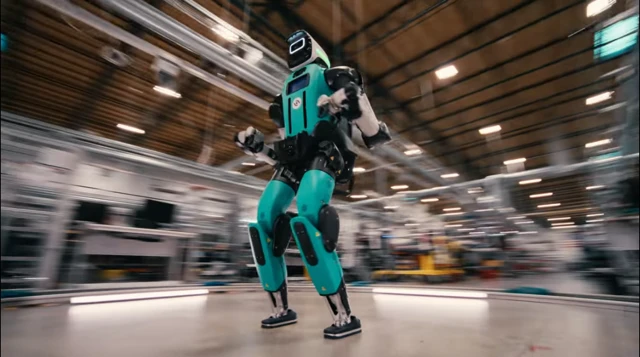
In the relentlessly iterating world of humanoid robotics, some designs become iconic. For Agility Robotics, their Digit robot was instantly recognizable for its “bird legs”—a backward-bending, ornithic design that was both a clever engineering solution and a fantastic bit of branding. It was different. It was weird. And now, it’s gone.
Agility has unveiled Digit V5, and the most glaring change is a complete leg-day transformation. The company has ditched its signature feature for a pair of decidedly more conventional, human-like legs. This isn’t just a cosmetic tweak; it’s a fundamental shift in design philosophy, trading a quirky trademark for brute-force pragmatism. The move signals that Agility is done with the science fair and is now laser-focused on conquering the factory floor.
The Great Unbending: A Leg Day Transformation
The original leg design, a legacy from Digit’s ancestor Cassie, was always justified with a practical explanation: the reverse-jointed legs allowed the robot to get its center of mass closer to shelves and bins. It was a neat trick for a robot designed for logistics. But three years of continuous commercial deployment and over 65,000 hours of real-world operation have a way of exposing the difference between a neat trick and a non-negotiable requirement.
The new anthropomorphic legs on Digit V5 are all about one thing: lifting. In an interview, Cofounder and Chief Robotics Officer Jonathan Hurst laid it out plainly, explaining that with the old design, “the ankles hit the ground, and you can’t get down very far.” The new configuration, powered by proprietary cycloidal actuators, allows Digit to squat fully and repeatedly lift up to 50 lb (22.7 kg) loads. This isn’t an arbitrary number; it’s designed to cover single-person lift tasks as defined by OSHA, a critical requirement for any robot hoping to work alongside humans in US facilities.
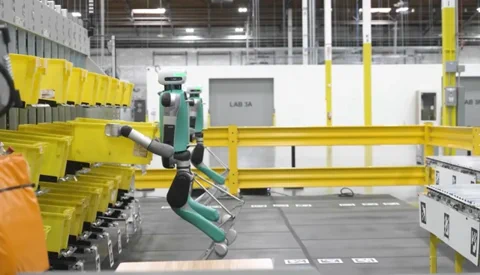
So, the answer to “Why the change?” is brutally simple: customer feedback and the unforgiving laws of physics in a warehouse. The previous design was optimized for walking and running, but as Hurst admitted, “We don’t need to run a marathon with this robot. We need to lift heavy things.”
More Than Just a Pretty Gait
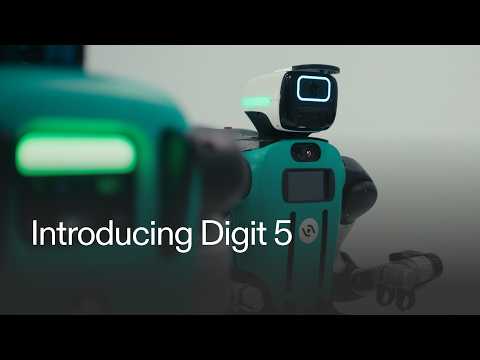
While the legs are grabbing the headlines, the rest of Digit V5 is a testament to what Agility has learned from its extensive pilot programs with partners like Amazon. The robot now stands a more commanding 5’ 11" (1.81 m) and weighs a hefty 284 lbs (129 kg). But the most jaw-dropping spec is its efficiency.
Thanks to a new battery system, Digit V5 boasts a 10:1 run-to-charge ratio. It can operate for a full 90 minutes and then autonomously charge itself in just nine minutes. Do the math: that enables over 20 hours of productive work in a 24-hour day, a massive leap from the previous 2:1 ratio and a potential game-changer for fleet uptime.
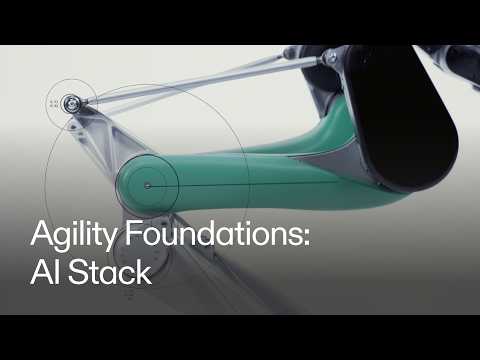
The robot’s brain has also been upgraded. Agility is building out its “physical AI” stack, a multi-layered approach to intelligence. It starts with capable hardware, adds a coordination layer to manage its motors a thousand times a second, and then defines skills through methods like teleoperation or simulation. Tying it all together is a cognitive AI layer, likely leveraging large language models, to sequence these skills and interpret complex commands in a dynamic environment. Safety is also paramount, with a new architecture built on NVIDIA’s IGX Thor and Halos framework designed to allow Digit to work near people without the cages required by traditional automation.
Forged in the Fires of Logistics
What truly separates Agility from many of its headline-grabbing competitors is its tenure in the field. While others are still demonstrating carefully curated lab experiments, Digit has been clocking in at real facilities for years. This experience is the foundation of the V5’s design. The company isn’t guessing what the market needs; its customers, including logistics giant Amazon, are telling them directly.
This pragmatic, customer-driven approach is what makes the leg-design pivot so significant. It’s an admission that in the world of industrial automation, what looks cool is secondary to what works, what’s safe, and what delivers ROI. The robot also features swappable end-effectors with ISO-standard mounts, another nod to industrial practicality, allowing its “hands” to be changed for different tasks.
The market seems to agree. According to CEO Peggy Johnson, Agility has already taken more than $300 million in multi-year orders for the new model, a powerful vote of confidence.
The Humanoid Conundrum: Conformity vs. Innovation
The evolution of Digit raises a fascinating question for the industry: are we witnessing the emergence of a “standard model” for the industrial humanoid? Just as the automotive industry eventually settled on a dominant design, the pressures of physics, safety regulations, and workplace ergonomics may be forcing humanoid makers down a path of convergent evolution.
Digit V5’s more human-like form now more closely resembles offerings from Figure AI and Tesla. It’s a departure from the wilder, more dynamic (and terrifying) acrobatics of Boston Dynamics’ Atlas, but for the repetitive, unglamorous work of a warehouse, perhaps conformity is king.
The switch from a unique, bio-inspired design to a more conventional one might feel like a loss of personality, but it’s the clearest sign yet that Agility Robotics is no longer a research project. Digit V5 is a product, honed by real-world data and engineered to solve a specific, colossal problem. It may have lost its quirky legs, but in doing so, it may have finally found its footing for the industrial long haul.