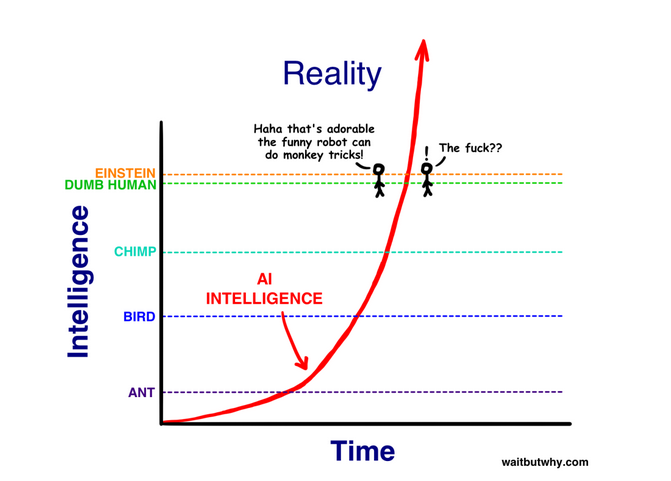
Tim Urban compressed into a single drawing an idea that robotics and artificial-intelligence professionals find increasingly difficult to set aside. The graph is not a measurement or a precise forecast. It is a thinking aid: a picture of how easily we can view an exponentially changing world through a linear lens.
Source: Wait But Why / Tim Urban
In February 2025, Urban wrote that humanoid robots and drones would be everywhere within 10–20 years: delivering packages, cleaning, making coffee, guiding shoppers and, eventually, taking on household tasks. In his compact comparison, these machines could feel “as normal as smartphones do today.”
The Humanoid Hub’s post highlighted that prediction and carried it to a wider robotics audience.
We can debate whether this will take 10, 20 or 30 years. The more important question is not the date but the direction. AI is no longer limited to generating text and images: it increasingly gives physical machines better perception, planning and decision-making. Sensors are becoming cheaper, batteries and actuators are improving, and manufacturers are collecting more data from real environments.
That does not mean every spectacular humanoid demo will soon become a dependable product. On the contrary, our analysis of ICRA 2026 found that the real competition is not about the best-choreographed video. It is about data, components, foundation models, manufacturing capacity, safe deployment and scalable business models.
China: an end-to-end supply chain and a mass market
China is not betting everything on a single “national humanoid.” It is building markets for motors, reducers, sensors, chips, batteries and robotic foundation models while seeking real applications in factories and services. The objective is not technological prestige alone, but a domestic supply chain capable of manufacturing robots in volume and at progressively lower cost.
Consumer demand matters just as much. Our earlier analysis explained how China is linking AI-product manufacturing with policies that stimulate household demand. If robots gain markets not only in factories but also in homes, elder care and retail, they could generate a scale of usage data and manufacturing experience that will be difficult to catch up with later.
Shenzhen: turning strategy into numerical targets
Shenzhen deserves separate attention because national ambition becomes an operational industrial plan there. The city’s 2025–2027 action plan targets breakthroughs in AI chips, multimodal perception, precision motion control and dexterous manipulation, among other fields.
By 2027, Shenzhen plans a cluster of more than 1,200 companies, associated industries worth over 100 billion yuan and at least 50 application scenarios worth one billion yuan each. The city’s wider AI programme opens 60 priority application areas, from manufacturing and urban operations to elder care. This is the crucial point: it is creating not only research grants, but markets, deployment sites and first customers.
Japan: demographics no longer allow delay
For Japan, robotics is not a futuristic hobby but one of the conditions for keeping a shrinking and ageing society operational. Its industrial policy toward 2040 connects investment in AI and robotics to labour shortages, productivity and the continuity of essential services.
The Ministry of Economy, Trade and Industry’s RING initiative connects municipalities, small and medium-sized enterprises, technology suppliers and support organisations so that robots do not remain confined to laboratories. Robot-friendly buildings, processes and standards are every bit as important as the machines themselves.
Our article on Japan’s robotics trajectory toward 2040 describes the potential scale. Ten million robots is an analytical scenario here, not a simple government unit target, but it demonstrates the scale of automation that may be required across supply, logistics, health care and elder care.
South Korea: a shared foundation model, data and standards
South Korea is trying to organise the industrial strength it built in semiconductors and electronics around humanoid robotics. The K-Humanoid Alliance brings together robot manufacturers, component suppliers, research institutes and AI companies. Robot firms are providing platforms for shared data collection and the development of a humanoid foundation model, while at least ten joint R&D projects and a dedicated investment fund are being prepared.
Korea is not postponing standards, either. Its strategy through 2028 calls for 21 Korean robot standards and 16 international standards proposals in areas including rehabilitation, wearable and home-service robots. Countries present when standards are written can also help shape the conditions of the future market.
Germany: turning industrial data into embodied AI
Germany is building on its manufacturing expertise, mechanical-engineering base and industrial data. The Robotics Institute Germany connects AI-based robotics research centres, while the 2026 Hightech Agenda envisages a dedicated AI-robotics booster programme.
Within Manufacturing-X, the RoX programme is a €52 million project involving 24 partners, building cloud-edge infrastructure and a shareable industrial-data ecosystem for AI robots. It is less photogenic than a humanoid walking across a stage, but background systems like these are what allow SMEs to deploy robots safely and economically.
United States: research, capital and rapid corporate experimentation
The US advantage does not come from a single central plan, but from a dense network of universities, technology companies, defence and industrial programmes, venture capital and large customers. The ARM Institute within Manufacturing USA, for example, aims to strengthen US manufacturing by linking robotics, AI and workforce development.
Yet the country has no reason for complacency in the race for scale. According to the International Federation of Robotics’ 2025 data, 34,200 industrial robots were installed in the US in 2024, bringing its operational stock to 393,700 — China’s stock was roughly five times larger. America’s world-leading AI research and capital will become a durable physical advantage only if manufacturing capacity and broad deployment keep pace.
What should Europe prepare for?
The right response is not to predict the exact year in which every shop will have a robot. We need to build capabilities that remain valuable across several possible futures.
- A measurable robotics and physical-AI strategy. It should include deployment, productivity, export and training indicators, not research goals alone.
- Real-world test environments. Hospitals, elder care, logistics, agriculture, municipal services and factories need controlled pilots.
- Financing for SME adoption. Most companies do not simply need to buy a robot. They need an integrator, process redesign, training and shared risk.
- Investment in people equal to investment in machines. Purchased hardware will not become productive without technicians, robot operators, integrators, safety professionals and AI engineers.
- Shared data and simulation infrastructure. Training robots requires high-quality industrial and service data that can be used lawfully.
- Safety built in from the beginning. Standards, liability rules, cybersecurity and independent testing are prerequisites for public trust.
- European added value. Europe does not necessarily have to manufacture an entire humanoid domestically. Sensors, control systems, simulation, industrial software, integration and specialised applications can all become strong positions.
- A social compact for the transition. Productivity gains must also support training, mobility and work that preserves human dignity. Preparation is a social task as well as a technological one.
The time to prepare is now
As a robotics expert, I am not claiming that humanoids will take over every occupation, or that Tim Urban’s timing is certain. I am saying that leading industrial nations are already acting as though physical AI will become strategic infrastructure. They are building supply chains, standards, datasets, test environments, financing and skilled workforces around it.
If they are wrong by a few years, the technological and industrial capabilities they acquire will still be useful. If they are right, however, the cost of delay will not be a few missed projects but lasting dependency and competitive disadvantage.
That is why we must prepare for this deliberately, at full strength and now — not with panic.