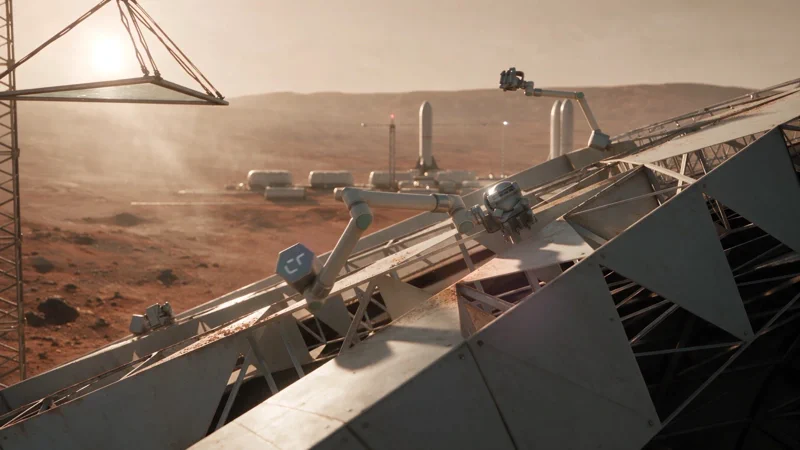
In the grand tradition of tech companies making ludicrously bold promises, a startup has decided that simply disrupting terrestrial industries is no longer enough. Cosmic Robotics, a Y Combinator alum, has officially thrown its hardhat in the ring for the Red Planet, publishing a detailed roadmap to begin constructing a city on Mars by the mid-2030s. And the best part? The initial construction crew won’t need oxygen, food, or psychological counseling for the 22-minute communication lag. They’re all robots.
While Elon Musk is busy building the interplanetary bus service with SpaceX, Cosmic Robotics is positioning itself to be the general contractor once the bus arrives. The company’s mission, as stated with a straight face, is “to build a city on Mars.” This isn’t just a fever dream sketched on a napkin; it’s a strategic plan from a company already deploying heavy-duty autonomous machinery on Earth and working under contract with NASA for lunar construction. This isn’t their first rodeo, it’s just their first one on another planet.
From Solar Farms to Martian Plains
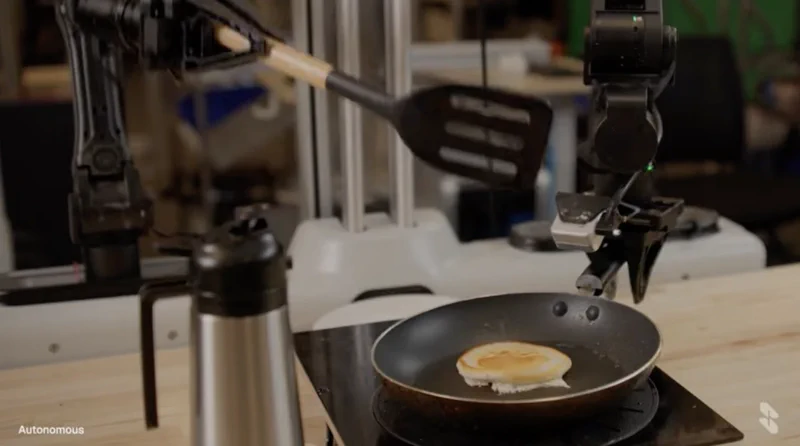
Before you dismiss this as another case of Silicon Valley hubris, consider what Cosmic Robotics is already doing. Their flagship machine, the 10,000 lb Cosmic-1, is currently hard at work on some of the largest solar farms in the United States. This autonomous beast handles 90-pound solar panels, placing them with millimeter precision in heat, rain, and snow, and has reportedly more than doubled the productivity of human crews. They’re also expanding into building the sprawling server farms that power our terrestrial cloud.
This Earth-based experience is the entire foundation of their Martian gambit. The founders, James Emerick (formerly of Built Robotics) and Lewis Jones (an alum of SpaceX, NASA JPL, and Relativity Space), argue that rockets are no longer the bottleneck for space exploration. The real challenge is what you do when you get there. Who’s going to pour the foundations, erect the habitats, and deploy the power grids? Their answer is a fleet of increasingly sophisticated robots, field-tested on Earth’s most demanding construction sites before being packed onto a Starship.
The company’s logic is brutally simple: if you can automate the construction of a data center in the Texas heat, you have a starting point for building a habitat on a planet where the average temperature is -60°C.
The Interplanetary General Contractor
Cosmic Robotics’ roadmap isn’t just a vague wish list. It outlines a phased approach, starting with the systems they’re already deploying and evolving them for the lunar and Martian environments. The core challenge they identify is labor—or the complete lack thereof in space. A city requires construction, manufacturing, and agriculture, all of which are impossible to bootstrap with a handful of astronauts. Robots are the only scalable solution.
The plan hinges on developing a suite of autonomous machines capable of:
- Site Preparation: Clearing and leveling terrain, a task far more complex on an alien world with unknown soil composition and no GPS.
- Infrastructure Deployment: Laying down power systems, solar arrays, and roadways.
- Habitat Construction: Assembling and sealing pressurized structures that can protect humans from the thin, carbon-dioxide atmosphere and deadly cosmic radiation.
The primary obstacle, beyond the sheer physics of it all, is autonomy. With a communication delay of up to 24 minutes each way, you can’t just joystick a robot from Houston. These machines need to be able to solve problems on their own, from navigating around an unexpected boulder to diagnosing their own mechanical failures.
A New Ecosystem is Being Built
The emergence of companies like Cosmic Robotics signals a crucial maturation of the commercial space industry. It’s no longer just about launch providers. An entire ecosystem is now taking shape to handle the “what next?” phase of space exploration. While NASA focuses on foundational science and exploration missions, and SpaceX perfects the transportation, a new layer of specialized companies is tackling the gritty work of off-world infrastructure.
This is less of a competition with SpaceX and more of a symbiotic relationship. Musk needs someone to build the Martian infrastructure his colonists will inhabit. Cosmic Robotics needs a reliable ride to get their 10,000-pound machines to the job site.
Of course, the road to a Martian city is paved with colossal engineering challenges, from the corrosive perchlorate-laced dust to powering heavy machinery in a world with frequent, planet-engulfing dust storms. But Cosmic Robotics is placing a calculated bet: that the hardest problems of off-world construction can be solved right here on Earth, one solar panel at a time. And if they’re right, the first Martian homeowners might have a robot to thank for their new digs.