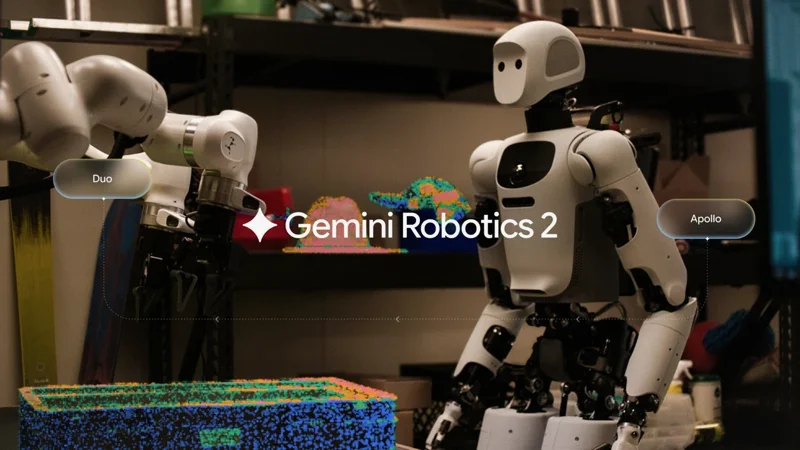
For years, the promise of helpful humanoid robots has felt like a demo on a permanent loop: impressive for 30 seconds, but ultimately confined to a lab, performing a single, pre-rehearsed task. They could pick up a block, sure, but couldn’t navigate a cluttered room without looking like a toddler who’d had too much sugar. Google DeepMind is now proposing a radical solution with Gemini Robotics 2, an AI platform that’s less of a software update and more of a full-blown brain transplant for robots of all shapes and sizes.
The pitch is deceptively simple: create a unified “intelligence layer” that can give any robot the ability to perceive, reason, and act in the messy, unpredictable human world. This isn’t just about finer motor control for a single arm; it’s about what Google is calling “full body intelligence.” For the first time, a single AI model is designed to control a humanoid from its feet to its fingertips, coordinating balance, locomotion, and manipulation into a single, fluid process. It’s the difference between programming a robot’s joints and giving it a mind of its own.
A Three-Headed AI Cerberus
At the heart of Gemini Robotics 2 is not one, but a trio of specialized models working in concert. Think of it as a command structure for getting things done in the physical world.
First, there’s Gemini Robotics 2 itself, the master vision-language-action (VLA) model. This is the workhorse, translating a high-level command like “put the watering can on the bottom shelf” into the complex sequence of motor controls required to walk, bend, balance, and place the object.
Second is Gemini Robotics ER 2, the “Embodied Reasoning” model. This is the strategist. It watches a continuous video feed of the real world to understand context, plan multi-step tasks, and even course-correct when things go wrong. If the main model is the body, ER 2 is the high-level brain that figures out the what before the VLA figures out the how. It can even call on external tools like Google Search to inform its plans.
Finally, there’s On-Device 2, the quick-change artist. This lightweight VLA is optimized to run locally on a robot’s hardware, but its killer feature is adaptation. Google claims it can be adapted to a completely new robot body—with different sensors, joints, and mechanics—in just a few hours, using fewer than 200 demonstrations. This is a monumental step away from the traditional, hardware-specific AI development that has plagued the industry for decades.
Beyond the Workbench, Into the World
The real test of any robotics AI is its ability to handle tasks that require more finesse than a factory assembly line. Gemini Robotics 2 is explicitly designed to move beyond the tabletop and into complex, real-world scenarios. The demos showcase a new level of dexterity, from controlling a five-fingered, 22-degree-of-freedom hand to unscrew a lightbulb (with a 92% success rate) to tying a knot in a trash bag (a more humbling 44% success rate).
This leap in capability is made possible by integrating the entire body into the decision-making process. In tests with Apptronik’s Apollo 2 humanoid, the robot achieved a 76.3% success rate retrieving objects from a shelf—a task that requires coordinated walking, balancing, reaching, and grasping.
But perhaps the most forward-looking feature is multi-robot collaboration. Gemini Robotics ER 2 can act as a central coordinator, dividing tasks between completely different types of robots. Imagine a humanoid like Apollo handing an object to a wheeled mobile robot for transport, each understanding its role in a larger workflow. This is where the platform’s ambition becomes clear: to create a common language for machines to work together.
The Android for Robots?
With Gemini Robotics 2, Google is making a strategic play to become the foundational operating system for the next generation of hardware. By creating a powerful, adaptable AI that can theoretically run on any machine, they are positioning themselves as the “brain” provider for a burgeoning ecosystem of robot “bodies.”
For developers and researchers, the good news is that parts of this powerful new tool are accessible. Gemini Robotics ER 2 is now available to developers through the Gemini API and Google AI Studio, allowing them to start building applications that leverage its advanced reasoning capabilities. This opens the door for the broader community to experiment with multi-step planning and real-world video understanding for their own robotic projects.
Of course, the gap between a stunning demo and a truly useful, reliable robot remains a chasm. The real world is infinitely more chaotic than a controlled lab. But by focusing on a generalized intelligence that can learn, adapt, and collaborate, Google DeepMind is building a bridge. They’re not just making a smarter robot; they’re trying to create a blueprint for all robots to become smarter. And for once, it feels like the demo reel might finally be catching up to reality.