
While the internet remains mesmerized by the latest humanoid robot performing a clumsy pirouette or folding a t-shirt with the speed of a tectonic plate, the adults in the room have moved on. At the IEEE International Conference on Robotics and Automation (ICRA) 2026 in Vienna—a gathering of thousands of the world’s top robotics minds—one of the most critical conversations had nothing to do with technical demos. Instead, it was a brutal dose of geopolitical reality.
The panel, titled “Robots for All” in a Fragmented World: Competing Global Visions and Shared Futures from Europe, Asia, and the United States, served as a stark reminder that the next great robotics race won’t be won in the lab. It will be decided by industrial strategy, social trust, regulatory savvy, and the unglamorous work of actual, large-scale deployment. The message was clear: spectacular prototypes are nice, but the real prize is economic sovereignty.
The Myth of the Monolithic Robot Future
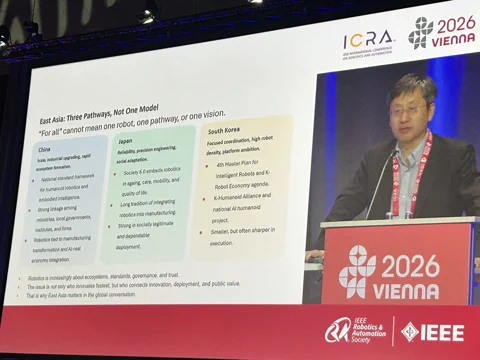
The current discourse is dangerously dominated by the idea of a universal humanoid, a one-size-fits-all solution for factories, hospitals, and homes. It’s a compelling narrative for investor decks but a poor reflection of reality. A key insight from the panel, delivered by Hesheng Wang, a Chair Professor from Shanghai Jiao Tong University, cut through the noise: “‘For all’ cannot mean one robot, one pathway, or one vision.”
This single sentence dismantles the simplistic notion of a global robot monoculture. The future of robotics is being forged in the crucible of regional ambitions, shaped by vastly different economic structures, demographic pressures, and cultural values. What works in China’s state-driven industrial ecosystem won’t simply copy-paste to Japan’s precision-engineering and socially-integrated model. What gets funded in Silicon Valley won’t necessarily survive in Europe’s regulatory landscape.
East Asia: Three Distinct Paths to Dominance
The panel provided a fascinating breakdown of the divergent strategies within East Asia, often mistakenly viewed as a single tech bloc.
China: The strategy is one of word: scale. Fueled by tight integration between government, academia, and industry, China is building entire robotics ecosystems at a dizzying pace. The goal isn’t just to build robots; it’s to embed AI into the physical economy and establish national standards for everything from embodied intelligence to humanoid supply chains. The estimate of over two hundred humanoid startups in China alone highlights the sheer velocity, but also begs the question of how many will find a sustainable market.
Japan: Following a different playbook, Japan focuses on reliability, precision engineering, and deep social integration. With a long history of industrial automation and a rapidly aging society, robotics is seen as a core solution for everything from manufacturing to elder care. The Japanese approach may appear slower, but it prioritizes long-term stability and public trust over flashy, short-term demos. With a robot density of 446 units per 10,000 employees, its methodical approach has already yielded one of the world’s most automated economies.
South Korea: The approach here is concentrated coordination and aggressive execution. Despite its smaller size, South Korea boasts the world’s highest robot density, with a staggering 1,220 robots per 10,000 employees. This is the result of clear national plans, like the Master Plan for Intelligent Robots, and a relentless focus on execution, particularly in building out its “K-Humanoid Alliance” and national AI projects.
Europe’s Gambit: Don’t Play Someone Else’s Game
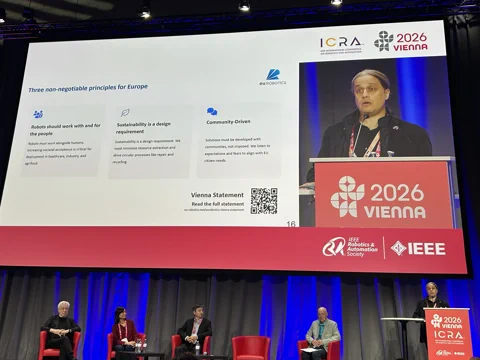
Faced with China’s scale and America’s venture capital firepower, Europe could easily fall into the trap of trying to be a “slower China” or a “more regulated Silicon Valley.” According to Francesco Ferro, the newly appointed President of euRobotics and CEO of PAL Robotics, that would be a strategic blunder.
Instead, Europe must leverage its unique strengths. The euRobotics Vienna Statement, unveiled at ICRA, outlines a strategy built not on imitation, but on a distinct European identity.
The three non-negotiable principles for Europe:
- Robots should work with and for the people, not only instead of them.
- Sustainability is a design requirement, not an afterthought.
- Solutions must be community-driven, not imposed.
These principles may sound less thrilling than a new AI model, but they are Europe’s competitive advantage. They directly address the biggest hurdle to mass adoption: social acceptance. In a region with strong labor protections, high consumer standards, and an aging population in desperate need of solutions in healthcare and agriculture, building trust is not a PR exercise—it’s the entire business case.
The Unsexy Infrastructure of Success
The consensus from the panel, which also included insights from Oussama Khatib, Director of the Stanford Robotics Lab, was that the transition from a functioning prototype to a commercially viable product is a valley of death littered with brilliant failures. Why? Because success depends on an infrastructure of trust that most tech companies treat as an afterthought.
A robot can be a technical marvel yet fail spectacularly if workers see it as a threat, patients don’t trust it, insurers can’t underwrite it, or regulators create a decade of uncertainty. Social acceptance isn’t a marketing campaign; it’s a feature that must be designed from the ground up, involving users, addressing liability, and proving a clear return on investment.
The hard truth is that the humanoid hype, while great for generating clicks, is a distraction. The real “killer app” for robotics won’t be a single, all-purpose machine. It will be a diverse ecosystem of specialized, reliable, and trusted systems solving urgent problems—from automating tasks in agriculture to supporting caregivers in elder homes. The winner of the global robotics race won’t be the one with the most-viewed YouTube demo, but the one who solves the most real problems, durably and economically. And that, it turns out, is a much harder, and far more interesting, challenge.