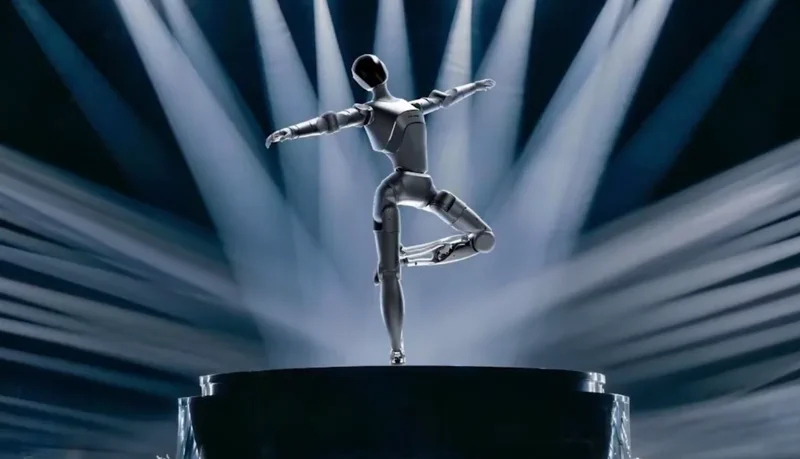
Just when you thought the humanoid robot race was exclusively about who could most efficiently stack boxes or weld a car door, Shenzhen-based LimX Dynamics has pirouetted onto the stage with a different ambition. Meet Luna, a full-size humanoid that seems less interested in manual labor and more concerned with mastering its catwalk and gymnastics routines. Unveiled in a live launch event, Luna is being pitched not as a factory workhorse, but as an interactive performer, a “limitless art” in fluid motion.
While competitors are laser-focused on automating the world’s dull, dirty, and dangerous jobs, LimX is making a calculated bet on a different market: entertainment. The humanoid robot market isn’t just for logistics anymore; it’s getting its own Vegas residency. And with the global market for entertainment humanoids projected to explode from around $310 million in 2024 to nearly $7.8 billion by 2034, it’s a bet that could pay off spectacularly.

Not Just Another Pretty Faceplate
Luna stands at a human-like 160cm (about 5'3") and weighs 54kg, but the spec sheet quickly diverges from its more utilitarian cousins. It’s a sleeker, more elegant machine than the company’s previous general-purpose humanoid, Oli, which was built for more rugged, all-terrain research. Luna’s design language is deliberately softened with premium textile finishes, aiming for “approachable aesthetics” over an industrial vibe.
Under the hood, however, it’s all business. Luna is powered by a second-generation “Sys 0” motion engine with upgraded joint motors and 27 degrees of freedom, enabling it to pull off advanced maneuvers like side flips and the Ilyushin spin. The company boasts some serious performance enhancements, including a 30% reduction in joint surface temperature thanks to upgraded thermal management—critical for preventing a meltdown during an extended dance number. More impressively, an enhanced battery management system boosts endurance by 150%, offering about 4 hours of untethered performance. For those all-night raves, it can also be plugged in for 24/7 operation.
This isn’t the first bipedal robot from LimX Dynamics, a company founded in 2022 that has rapidly raised over $296 million from heavy-hitters like JD.com and Alibaba. Their portfolio includes the more research-focused Oli humanoid and the modular TRON biped. Luna represents a strategic pivot, or at least a significant diversification, into a commercial vertical where aesthetics and performance are the main product.
The AI Choreographer and The Robot Army
What truly sets Luna apart is its brain, or rather, the software that makes it dance. LimX has equipped Luna with a suite of tools designed for non-roboticists. The “Video to Motion” feature allows a user to simply upload a video of a human dancing, and Luna’s AI analyzes and replicates the movements. This, combined with kinesthetic “teach by showing” programming and an AI Task Editor, lowers the barrier to creating complex routines from a coding marathon to a simple natural language prompt.
Simply describe your scenario, and AI composes dance, motion, visual, and voice into complete tasks.
This ease of use is crucial, but the real showstopper is the swarm control. A single operator can synchronize and command a troupe of over 200 Luna units with millisecond precision. The implications are obvious: massive, visually stunning robotic performances at opening ceremonies, concerts, and theme parks. Forget a flash mob; we’re talking about a flash-robot spectacle.
Of course, with a fleet of high-kicking robots comes the inevitable safety question. LimX has implemented a four-layer safety architecture that includes active fall mitigation (it goes into a damped state to soften the blow), external force sensing to halt operations upon impact, and the ever-reassuring big red hardware emergency-stop button.
A New Niche in the Humanoid Market
Luna isn’t here to compete with Figure in a factory or Tesla’s Optimus in a lab. It’s carving out a new role for humanoids as brand ambassadors, performers, and interactive centerpieces. The public debut at the Taobao Influencer Festival in March 2026, complete with a red-carpet catwalk, underscored this strategy perfectly. This is a robot designed to be seen.
While no official pricing has been listed for international markets, some reports from its China release peg the starting price around $43,000, with an introductory offer for the first 100 units at $38,000. This places it in a professional-grade category, well above consumer toys but potentially accessible for businesses in the events and entertainment space. For comparison, the more development-focused LimX Oli EDU platform is listed at nearly $60,000.
The launch of Luna signals a fascinating maturation of the humanoid market. As the underlying technology of bipedal locomotion and AI control becomes more robust, companies are beginning to specialize. Not every humanoid needs to be a general-purpose jack-of-all-trades. Some can be specialists, and Luna is the first high-profile humanoid to specialize in the art of performance. The robot revolution might not just be about automating labor; it might also be about automating the limelight.