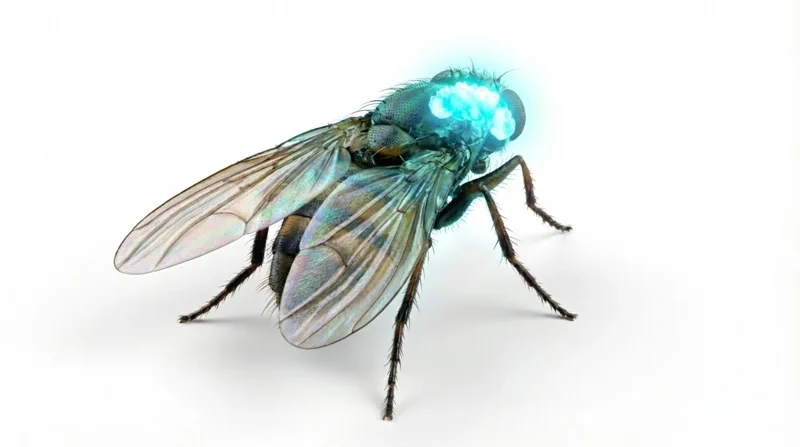
In a move that feels ripped from the pages of a dusty science fiction paperback, San Francisco-based EON has performed a feat of digital necromancy. They took the complete brain map of a fruit fly, plugged it into a simulated body, and watched it move. This isn’t an animation or a machine learning algorithm mimicking a fly; it’s a direct emulation of a biological brain’s wiring, and according to EON’s founder Michael Andregg, it achieved 91% behavioral accuracy right out of the box.
The era of whole-brain emulation has apparently buzzed to life, not with a thunderous pronouncement, but with the twitch of a virtual insect’s leg. For years, the concept of “uploading” consciousness has been a far-off, philosophical carrot dangled by futurists. But EON’s demonstration suggests the technical foundations are not only being laid but are already functional, albeit at a scale that won’t be threatening our biological supremacy just yet.
The Ghost in the Machine
So, how did they pull it off? The project stands on the shoulders of a massive collaborative effort called FlyWire, which painstakingly mapped the entire connectome—a neuron-by-neuron, synapse-by-synapse wiring diagram—of an adult fruit fly brain. This connectome comprises nearly 140,000 neurons and over 50 million connections, a labyrinth of biological circuitry now available as open data.
EON took this pristine map and applied a surprisingly simple neuron model known as “leaky-integrate-and-fire” (LIF). LIF models are a computational neuroscience classic, abstracting the complex biophysics of a neuron into a few basic rules: integrate incoming signals, leak some charge over time, and fire a spike when a threshold is crossed. This digital brain was then connected to NeuroMechFly, a hyper-realistic, physics-simulated fly body running in the MuJoCo physics engine.
The astonishing part, as Andregg notes, is that this Rube Goldberg contraption of neuroscience data and simulation software actually worked. “This shows how much information is captured by the architecture itself, rather than the neuron model,” he stated. It’s a powerful validation for the connectomics field, suggesting that the wiring diagram is indeed the most critical piece of the intelligence puzzle.
The Fine Print on Immortality
Before we all rush to digitize our own gray matter, it’s worth reading the caveats, which are significant. First, the original FlyWire scan was just the brain, not the full nervous system and body. This means EON had to make educated guesses about how to connect the brain’s motor outputs to the simulated muscles of NeuroMechFly. It’s a real limitation, one the company plans to address by scanning both brain and body in future projects.
Second, the simple LIF neuron model has a major drawback: it lacks plasticity. This digital fly cannot form new long-term memories. It is a ghost trapped in a loop, its behavior dictated entirely by the frozen architecture of its biological past. It can react, but it cannot learn. Andregg acknowledges this, and also brings up the thorny ethical questions. “We don’t know what its experience is - nobody does,” he admits. “But we take the possibility seriously, and we’re working to give it a rich environment, not just a test box.”
From Digital Flies to AI Overlords?
This fruit fly is just the first buzz in what EON sees as a symphony of future emulation. Andregg lays out a grand, three-pronged vision:
- Understanding the Brain: Create perfect models to study neurological diseases.
- Discovering Intelligence: Reverse-engineer the algorithms evolution produced in “the most expensive training run in history.”
- Uploading Humanity: Offer a path to artificial superintelligence that is fundamentally aligned with human values because it is human.
This last point is a direct shot across the bow of today’s AI giants. Andregg frames whole-brain emulation as a democratic alternative to a future dominated by a few “opaque AI systems” built in secretive labs. The promise is a high-fidelity upload that preserves your memories and personality, but frees you from biological decay, allowing you to run “faster than real time” to keep pace with purely artificial minds.
What This Means for Robotics
For the robotics world, the implications are less about digital immortality and more about radical new control systems. For decades, roboticists have struggled to replicate the fluid, reactive grace of even simple animals. This work suggests a new path. Instead of trying to program intelligence from the top down, why not copy the schematics that nature has already perfected?
Imagine an autonomous drone navigating a dense forest with the agility of an insect because its control system is a direct emulation of an insect’s brain. Or a multi-legged robot that scrambles over rubble with the unthinking confidence of a cockroach. By emulating these nervous systems, we could unlock control algorithms for locomotion, navigation, and obstacle avoidance that are far more efficient and robust than anything designed with conventional machine learning.
This digital fly is a proof-of-concept. It demonstrates that closing the loop from a fully emulated brain to a physically simulated body is possible. The challenge now is one of scale. EON has its sights set on a mouse brain next—a jump from ~140,000 neurons to roughly 70 million. It’s an audacious goal. But if they succeed, the line between biology and robotics will begin to blur in ways we’re only just starting to imagine. The ghost is out of the machine.