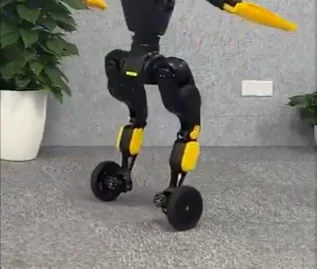
In the cacophony of AI hype, where digital minds are born at a dizzying pace, a quiet truth has been holding back the robot revolution: the bodies are still a pain to build. While software eats the world, robotic hardware is typically stuck in a 19th-century paradigm of painstaking, manual assembly. A Budapest-based startup, Allonic, thinks this is absurd, and they’ve just landed a cool $7.2 million in pre-seed funding to prove it. This isn’t just any funding round; it’s the largest of its kind in Hungarian history, and it’s all aimed at solving the industry’s most tedious, and perhaps most important, bottleneck.
The problem is one of complexity. Advanced robotic hands that mimic human dexterity are a nightmare of tiny screws, bearings, cables, and delicate joints—all assembled piece by piece. This makes them expensive, fragile, and incredibly slow to produce and iterate on. Allonic’s founders, Benedek Tasi, Dávid Pelyva, and David Holló, experienced this frustration firsthand while researching biomimetic hands at a university in Budapest. “We’d spend weeks assembling hundreds of tiny parts… getting stuck with old manufacturing methods,” said Tasi. “That’s when we realised the real problem wasn’t the design, it was how we were making it.”
Weaving the Future with 3D Tissue Braiding
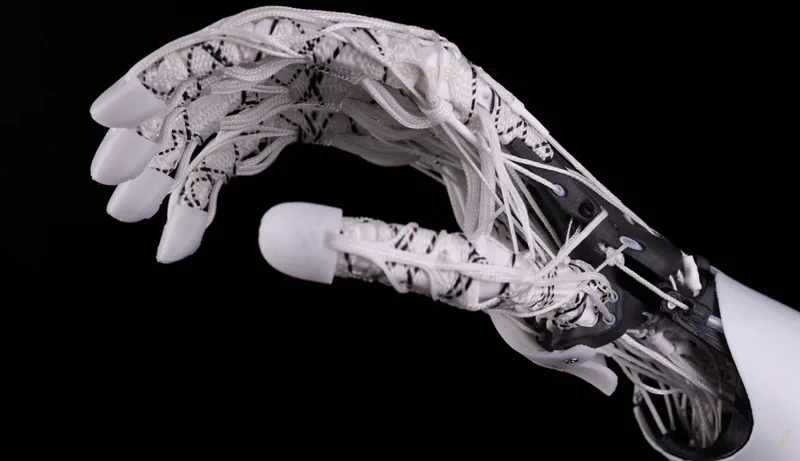
Allonic’s solution sounds like something out of science fiction, and it’s called 3D Tissue Braiding. Forget assembly lines. Think of a high-tech loom weaving a robotic limb into existence. The system starts with a simple skeletal frame and then automatically braids high-strength fibers, elastics, tendons, and even sensor wiring around it in one continuous, automated process. The result is a monolithic, fully-formed robotic part that’s strong, compliant, and ready for actuators to be connected.
“Instead of assembling hundreds of individual components, such as bearings, screws, and cables, we’re forming tendons, joints, and load-bearing tissues directly over a skeletal core,” explains CEO Benedek Tasi.
This approach collapses the entire manufacturing supply chain. A design can go from a CAD file to a physical, functional prototype in minutes or hours, not weeks. Allonic claims its second-generation machinery is already 5x faster and 2x smaller than its predecessor. For an industry where iterating on hardware is a costly, time-sucking ordeal, this is a monumental claim.

From Niche Labs to an “Infrastructure Player”
The $7.2 million round, led by Visionaries Club with participation from Day One Capital and angel investors from AI powerhouses like OpenAI and Hugging Face, signals a serious vote of confidence. It’s a recognition that without better hardware, all the brilliant AI in the world will remain trapped in clumsy, impractical bodies. “Hardware remains one of the most important bottlenecks in robotics,” says Marton Sarkadi Nagy, a partner at Visionaries Club. “We won’t get there if the hardware is not right.”
Allonic isn’t necessarily trying to build the next Atlas or Optimus itself. Instead, it sees itself as an “infrastructure player,” providing the manufacturing backbone for the entire robotics industry. The business model involves customers designing custom robot bodies on Allonic’s platform, which the company then produces and delivers. They’ve already completed a pilot project in electronics manufacturing, a sector crying out for manipulators more dexterous than simple grippers but less costly than a full humanoid.
The company is also fielding heavy interest from humanoid robotics firms and Big Tech players who understand that scaling their ambitious projects depends on cracking the manufacturing code.
The End of Assembly as We Know It?
Of course, a record-breaking pre-seed round and a slick demo do not a revolution make. The path from a brilliant manufacturing process to a global industry standard is long and fraught with peril. Allonic will need to prove its “woven” limbs can withstand the rigors of industrial use, match the precision of traditionally machined parts, and be produced at a cost that makes economic sense at scale.
Still, the concept is undeniably compelling. By tackling the least glamorous but most fundamental problem in robotics, Allonic is making a bold statement. While the world is mesmerized by the ghost in the machine, this Hungarian startup is quietly redesigning the machine itself. If they succeed, the future of robotics might not be assembled with a screwdriver, but woven on a loom.