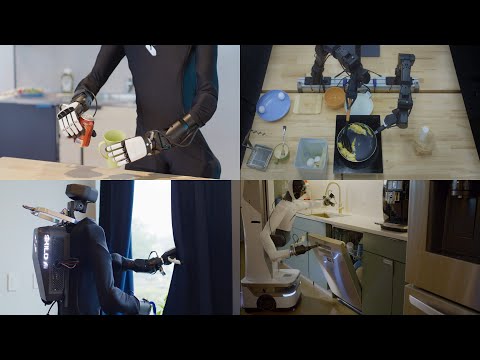
In the grand, often clumsy, marathon toward general-purpose robots, the industry has repeatedly tripped over the same inconvenient hurdle: data. While language models got to gorge themselves on the entire internet—a veritable all-you-can-eat buffet of text—robotics has been stuck hand-feeding its creations with the slow, expensive, and painfully limited diet of teleoperation. But now, a startup named Skild AI has decided to stop spoon-feeding and simply show its robots the menu. Their latest proof point? A robot arm that can whip up a plate of scrambled eggs after learning the skill by watching a human video.
This isn’t just a party trick. It’s a direct assault on what has become the central problem in physical AI: the data bottleneck. The prevailing method of training robots involves human operators remotely “puppeteering” a machine to collect the precise motor-control data needed for a task. As Skild AI points out, this strategy is saddled with two fatal flaws: it lacks diversity, as most data is collected in sterile lab environments, and it’s mathematically impossible to scale to the level needed for a true foundation model. You simply can’t hire enough humans to drive robots 24/7 to generate the trillions of data points required.
The YouTube-to-Robot Pipeline
Instead of trying to build a bigger data farm, Skild AI is tapping into one that already exists: the internet. The company’s core insight is that humans have already created an “internet-scale” dataset for robotics in the form of YouTube tutorials, TikTok hacks, and countless other instructional videos. The solution, hidden in plain sight, is observational learning—the same way humans learn. We don’t learn to pour a drink by calculating fluid dynamics; we watch someone else do it and our brain figures out the rest.
Skild AI is teaching its models to do the same. By watching videos of humans performing tasks, the AI learns the intent and the sequence of actions, effectively translating a visual demonstration into robotic commands.
Of course, it’s not that simple. Showing a robot a video of Gordon Ramsay making Beef Wellington and expecting a Michelin-star meal is pure fantasy. The primary technical challenge is what the industry calls the “Embodiment Gap.” A human hand has 27 degrees of freedom; a two-fingered gripper does not. Mapping the fluid motions of a human chef onto the rigid joints of a multi-axis robot arm is a monumental translation problem.
Omni-bodied Learning and the Skild Brain
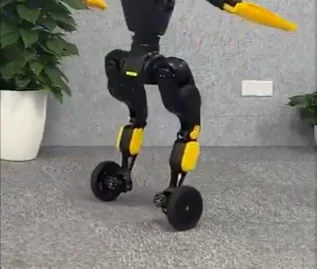
This is where Skild AI claims its secret sauce lies. The company has developed what it calls an “omni-bodied” foundation model, dubbed the Skild Brain. This AI is designed to be hardware-agnostic, capable of controlling various robot forms—from wheeled humanoids to stationary arms—without being over-specialized for any single one. The model is pre-trained on a massive diet of human videos and physics-based simulations, allowing it to build a generalized understanding of how objects should be manipulated.
“Learning by experience, and not pre-programming, is the step change that has happened in robotics,” the company stated, highlighting its use of NVIDIA’s simulation and AI infrastructure to acquire “a millennium of experience within days.”
This approach allows the robot to learn a new skill from video with less than an hour of robot-specific data for fine-tuning. The result is a system that can generalize across different tasks and environments, as seen in their demos of robots loading dishwashers, watering plants, and drawing curtains.

Implications for the Robotic Revolution
If Skild AI’s approach proves to be as scalable and effective as it claims, the implications are enormous. It fundamentally alters the economics of robot training. The need for vast, expensive teleoperation farms could be replaced by powerful models that learn from an ever-growing, publicly available library of human activity. This could dramatically accelerate the deployment of robots in unstructured environments like homes, restaurants, and construction sites—places where automation has traditionally struggled.
The industry is taking notice. Competitors in the humanoid and general-purpose robot space are all placing their own high-stakes bets on solving the data problem, whether through teleoperation, simulation, or human video.
For now, Skild AI has delivered a compelling, and frankly delicious-looking, demonstration. While the rest of the world is busy creating content for humans to watch, Skild is quietly turning that content into a curriculum for our future robot assistants. The age of the self-taught robot chef may be closer than we think.