Let’s be honest, when you think of Microsoft, you probably think of software that runs the world’s desktops, not the robots that will one day build them. The company’s history in robotics has been… intermittent. Many of us still have a dusty corner of our memory reserved for the Microsoft Robotics Developer Studio, a 2006-era attempt to create a “Windows for robots” that fizzled out. It was a noble effort, but ultimately a platform in search of a problem the market was ready to solve.
But this is 2026. The world has changed. Microsoft, supercharged by its deep alliance with OpenAI, is no longer just a software giant; it’s an AI behemoth. And it’s taking another, far more ambitious swing at robotics. This time, it’s not just about providing a developer kit. It’s about building a single, universal brain—a foundation model for the physical world that could power everything from a multi-jointed factory arm to a humanoid assistant. The goal is to finally bridge the gap between digital intelligence and physical action, a challenge known as embodied AI.
From Language Models to ‘Physical AI’
For years, robots have been incredibly effective in structured environments. An automotive assembly line is a paradise for a robot: every part is in a predictable place, every task is repetitive, and the margin for error is nil. But the moment you take that robot out of its cage and put it in the chaotic, unpredictable human world, it becomes a very expensive paperweight. This is the problem Microsoft is attacking.
The company’s big idea is to create what it calls “Physical AI,” leveraging the same principles that make models like GPT-4 so powerful. The new star of this initiative is Rho-alpha, Microsoft’s first robotics model built from its Phi series of vision-language models. As Ashley Llorens, a VP at Microsoft Research, puts it, this is about enabling systems to “perceive, reason, and act with increasing autonomy alongside humans in environments that are far less structured.”
In essence, they want to build a model that doesn’t just understand the command “pick up the blue box,” but also understands the physics of lifting, the common-sense knowledge that you shouldn’t crush the box, and the ability to adapt if the box is slightly out of place. It’s a move from brittle, pre-programmed instructions to fluid, adaptable intelligence.
The VLA+ Advantage: It’s All in the Touch
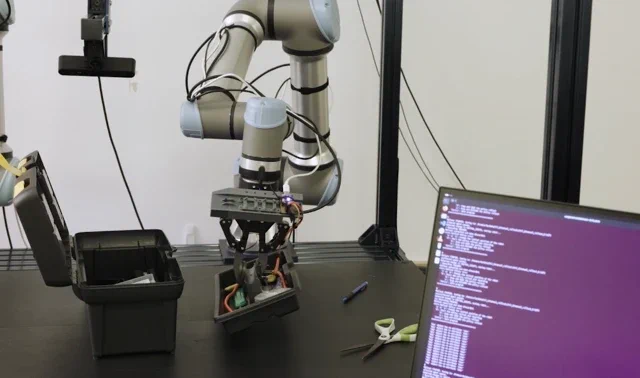
The secret sauce for Rho-alpha is its architecture, which Microsoft describes as a Vision-Language-Action Plus (VLA+) model. Unlike earlier models from competitors like Google DeepMind that primarily rely on vision and language (VLA), Rho-alpha adds a crucial sense: touch. By incorporating tactile sensing, the model can understand object contact states and perform delicate manipulations—like plugging in a cord or turning a dial—that are nearly impossible with vision alone.
Of course, building such a model runs into the biggest bottleneck in robotics: a massive scarcity of good data. You can’t just scrape the internet for trillions of examples of a robot picking up a screwdriver. To solve this, Microsoft is leaning heavily on simulation.
“Training foundation models that can reason and act requires overcoming the scarcity of diverse, real-world data,” says Deepu Talla, Vice President of Robotics and Edge AI at NVIDIA. “By leveraging NVIDIA Isaac Sim on Azure to generate physically accurate synthetic datasets, Microsoft Research is accelerating the development of versatile models like Rho-alpha.”
This combination of synthetic data generated in simulation with real-world physical demonstrations is the key to training these models at scale. When the robot inevitably messes up, a human operator can correct it with a 3D mouse, and the system learns from that feedback in real time.
An Operating System for Embodied Intelligence
If Microsoft succeeds, the implications are enormous. A general-purpose robotics model could function like a cloud-based operating system for hardware. Instead of every robotics company building its own complex AI stack from scratch, they could license a highly capable foundation model from Microsoft and focus on creating better hardware. This would dramatically lower the barrier to entry and could trigger a Cambrian explosion of new robotic forms and applications.
This places Microsoft in direct competition with other tech titans who have the same idea. NVIDIA, with its Project GR00T, is building a similar foundation model, leveraging its dominance in AI hardware and its Omniverse simulation platform to create a powerful ecosystem play. Tesla is taking a vertically integrated approach with Optimus, betting that its vast trove of real-world driving data will give it an edge in physical world understanding. And Google has been a research powerhouse in this space for years.
Microsoft’s strategy seems to be a platform play. By making Rho-alpha available through an early access program and later via Microsoft Foundry, it is inviting partners to build upon its foundation. This collaborative approach, backed by the immense scale of Azure cloud infrastructure, is Microsoft’s core advantage.
The dream of a general-purpose robot is still a long way from reality. The challenges of real-world physics, safety, and cost are monumental. But for the first time, the software is starting to feel plausible. Microsoft’s ambitious push into “Physical AI” isn’t just another research project; it’s a clear signal that the race to build the brain that will power the next generation of machines is well and truly on. And this time, Microsoft is a very serious contender.