Not long ago, the pinnacle of drone swarm technology was a light show. In Liuyang, China, a company called High Great Technology launched 15,947 drones from a single computer, setting a new Guinness World Record for the most unmanned aerial vehicles airborne simultaneously. It was a stunning display of synchronized, AI-driven coordination—a beautiful, harmless ballet of lights painting pictures in the night sky. But while the world applauded the spectacle, the underlying technology was quietly preparing for a much grimmer performance.
The same AI that prevents 15,000 drones from becoming a rain of expensive confetti is now guiding weapons to their targets. The evolution from choreographed entertainment to autonomous combat hasn’t been gradual; it’s been a vertical climb. The barrier to entry for air superiority, once measured in billions of dollars and decades of pilot training, has suddenly plummeted to the cost of a few microchips and some clever code. Pandora’s box isn’t just open; its contents are already deployed.
The Swarm Gets Lethal
The leap from light shows to combat wasn’t just theoretical. The coordination seen in Liuyang is the same foundational principle that allows a swarm of drones to navigate a dense forest without a human pilot, a feat demonstrated by researchers at Zhejiang University. This is about more than just collision avoidance; it’s about collective, autonomous problem-solving in a complex, dynamic environment. Now, replace the trees with enemy air defenses and the navigation points with targets.
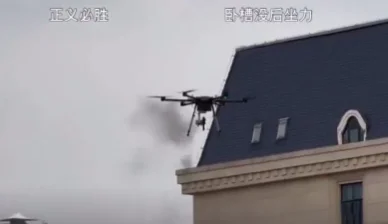
This brings us to the next logical, and terrifying, step: reusable, armed drones. A video that surfaced recently shows a Chinese-made hexacopter armed with a machine gun. The marvel isn’t the weaponization itself—anyone can strap a gun to a drone. The breakthrough is the software. The drone fires, and the brutal recoil that should send a lightweight aircraft tumbling is instantly absorbed by the flight controller. The stabilization is so perfect it remains locked on target, ready for follow-up shots.

This isn’t just a “loitering munition” or a one-way suicide drone anymore. This is reusable, artificially intelligent flying infantry. Why invest millions in training a human soldier when a $2,000 unit with perfect aim, no fear, and flawless recoil control can be mass-produced? The economics of warfare have been irrevocably broken. A $500 DIY drone can now credibly threaten an $82 million fighter jet, an exchange rate that is fundamentally unsustainable for any conventional military.
The AI Kill Chain is Live in Ukraine
This isn’t a future-war scenario. It’s happening right now. Ukrainian forces have begun the daily combat use of AI-powered attack drones. Once launched, these drones can find, track, and engage targets entirely on their own, a critical capability when Russian electronic warfare (EW) jams the signal to a human pilot. Autonomous killing has officially entered the war.
These are not simple “fire-and-forget” systems. They are equipped for:
- Terminal Attack Guidance: The AI takes over in the final, critical moments to ensure a hit, even if the pilot has lost connection.
- Autonomous Target Recognition: Drones can be trained on what a tank or a missile launcher looks like, and then hunt for them without specific human designation.
- GPS-Denied Navigation: Using visual navigation, where the drone compares the terrain below to an onboard map, it can fly hundreds of kilometers through heavy jamming, rendering traditional countermeasures obsolete.
One of the key systems is a drone called Bumblebee, reportedly backed by a project linked to former Google CEO Eric Schmidt, which has flown thousands of combat missions. In one documented strike, human-piloted drones were stopped cold by Russian jammers. A Bumblebee drone, however, had already locked onto its target. It lost its data link, continued its flight path autonomously, and destroyed the target. Russian military analysts later admitted they have no effective defense against it.

A New Defense-Tech Ecosystem
This revolution is being driven by a new wave of agile defense-tech companies. Ukrainian firms like NORDA Dynamics and X-Drone are supplying tens of thousands of AI-powered systems to the front lines. NORDA Dynamics, which recently secured $1 million in funding, develops autonomy modules like “Underdog” that can be integrated into various UAVs, enabling them to operate without GPS or a constant data link. They are, in their own words, scaling autonomy modules to “tens of thousands of combat deployments.”
The operator’s role is shifting from a pilot to a mission commander. A single person can now manage dozens of semi-autonomous drones, designating targets and letting the AI handle the complex flight and terminal guidance. This isn’t just a force multiplier; it’s an entirely new paradigm of combat.
The pretty lights that danced in the sky over Liuyang were a demonstration of control. They showed the world a mastery of AI-driven swarm robotics. Now, that same mastery is being applied with lethal precision on the battlefield. The technology has been proven, the economic case is brutally compelling, and the first shots of the autonomous drone war have already been fired. We are living in the first minutes of a new and unsettling age.