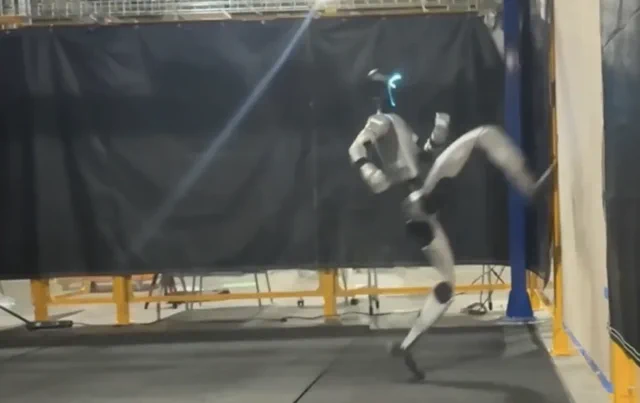
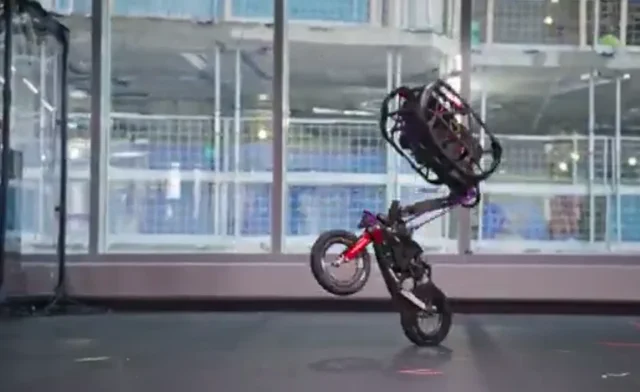
For years, humanoid robots have been the awkward teenagers of the tech world: great at choreographed dances and backflips, but hopelessly clumsy when asked to perform a useful chore. The robotics industry has long been stuck on “loco-manipulation”—the fiendishly complex problem of getting a robot to walk and use its hands at the same time without collapsing into a heap of regret and expensive parts.
Enter Figure AI with Helix 02, a new AI model that doesn’t just walk and chew gum; it walks, carries delicate dishes, and unloads a dishwasher in a continuous, four-minute autonomous sequence. This isn’t another slick, short-horizon demo. It’s a demonstration of a single neural network controlling an entire humanoid body, from pixels to torque, finally bridging the gap between locomotion and manipulation.
The End of Stitched-Together Robots
Traditionally, getting a humanoid to do anything useful involved a clunky, Frankenstein’s monster of code. One controller would handle walking, which would then hand off to another for stabilization, which would then pass the baton to a third for reaching and grasping. The result was a slow, brittle, and profoundly unnatural process. If an object shifted unexpectedly, the whole fragile tower of logic would come crashing down.
“True autonomy requires something fundamentally different: a single learning system that reasons over the whole body at once,” Figure’s announcement states. “A system that continuously perceives, decides, and acts.”
This is the core problem Helix 02 was built to solve. Instead of stitching together disparate systems, Figure created a hierarchical AI architecture that thinks and acts as a unified whole.
A Three-Layered Brain for a Body
The magic behind Helix 02 lies in a three-system architecture, each operating on its own timescale. Think of it as a corporate ladder for thoughts, from the CEO setting the strategy to the intern actually doing the work.
- System 2 (The Strategist): This is the high-level reasoning layer. It processes scenes and language, breaking down a command like “Unload the dishwasher” into a sequence of goals. It operates slowly, thinking about the big picture.
- System 1 (The Tactician): This is the visuomotor policy that connects all the robot’s senses—head cameras, new palm cameras, and fingertip tactile sensors—to all its joints. It translates S2’s goals into fast, 200 Hz full-body commands.
- System 0 (The Athlete): This is the foundation, a model trained on over 1,000 hours of human motion data. It operates at a blistering 1 kHz, ensuring every movement is stable, balanced, and natural. In a stunning flex, Figure notes that System 0 replaces 109,504 lines of hand-engineered C++ with a single neural network. They essentially fired a library’s worth of code and hired an AI that learned by binge-watching humans.
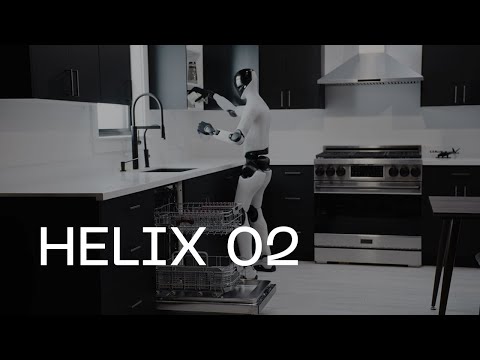
This “pixels-to-whole-body” pipeline allows the robot to perform 61 distinct loco-manipulation actions in its four-minute dishwasher ballet, fluidly transitioning between walking, carrying, placing, and even using its hip to close a drawer when its hands are full.
So, What Can It Actually Do?
The dishwasher task is the star of the show, but the introduction of new hardware on the Figure 03 robot, specifically palm cameras and tactile sensors, unlocks a new tier of dexterity. These sensors give Helix 02 the feedback needed for tasks that were previously out of reach for purely vision-based systems.
The tactile sensors can detect forces as small as three grams, which is sensitive enough to feel a paperclip. This enables a whole new class of fine-motor skills.
Dexterity Beyond the Dishes
Helix 02 was put through a gauntlet of dexterous tasks to prove its fine-motor bona fides:
- Unscrewing a bottle cap: Requires precise, bimanual coordination and force control to avoid crushing the bottle.
- Picking a single pill from an organizer: Uses palm-level cameras for a close-up view when the main head cameras are occluded.
- Dispensing exactly 5 ml from a syringe: A task demanding tactile feedback to apply smooth, continuous force.
- Singulating metal parts from a cluttered box: A real-world task from Figure’s own BotQ manufacturing facility, showcasing its ability to work in messy, unpredictable environments.
Analysis: A Step-Change for Useful Humanoids
While other companies have shown robots performing impressive athletic feats, Figure is focusing on the unglamorous but critical challenge of making humanoids useful in the real world. The leap from the original Helix, which only controlled the upper body, to Helix 02’s full-body autonomy in just a year is a significant marker of the accelerating pace of progress in the field.
The key takeaway is the move away from brittle, hand-coded behaviors toward a learned, adaptable system. By training its foundation model on a massive dataset of human movement, Figure is embedding a natural prior for how a bipedal form should move and balance. This allows the higher-level AI to focus on what to do, while the lower-level system handles the how.
This is less about building a robot that can do one thing perfectly and more about creating a platform that can learn to do anything. As Figure CEO Brett Adcock has noted, improvements to the Helix neural network can be fed back to the entire fleet, allowing all robots to benefit from the learnings of one. With the robot’s actuators reportedly running at only 20-25% of their peak speed, there is a massive ceiling for performance improvement on the current hardware.
The results are still early, but they represent a fundamental shift. By solving the continuous, whole-body autonomy problem, Figure has taken a crucial step toward creating a true general-purpose robot—one that might finally be ready to do the chores, no state machines required.