Let’s get one thing straight: this is not financial advice. If you take this article, march to your broker, and wager your life savings on a bipedal robot startup, that’s on you. What follows is a brutally honest survey of the humanoid robotics landscape as we enter 2026, based on publicly available data. This sector is a minefield of spectacular promises and crushing realities. It’s a place where fortunes could be made, but where capital goes to die a fiery, hypothermic death. Proceed with caution.
The hype, for once, might have some substance. Analysts at Goldman Sachs have dramatically revised their forecasts, now calling for a $38 billion humanoid robot market by 2035, a six-fold increase from their previous estimates. The reason? AI is finally getting smart enough to make these machines useful, and the convergence of demographic cliffs, labor shortages, and a geopolitical scramble to re-shore manufacturing has created a perfect storm for automation. In 2026, the dream of science fiction is colliding with the hard reality of economics.
The Macro Tailwinds: Why Now?
Three powerful forces are dragging humanoid robots from the lab into the real world. First, the demographic cliff. The United States faces a manufacturing labor shortfall of nearly 2 million workers by 2033, and the situation is even more dire in Japan and Germany. The question for businesses is no longer “Is a robot cheaper than a human?” but “Can I get a robot to do the job that I can’t find a human for?”
Second is the dawn of “Physical AI.” While generative AI like ChatGPT learned to master language, Physical AI is about teaching machines to perceive, reason, and act in the messy, unstructured physical world. Companies like Nvidia are building the foundational models—like Project GR00T—and the silicon brains (Jetson Thor) to make this happen, turning every robot into a learning machine.
Finally, there’s the great supply chain reshuffling. The geopolitical friction between the US and China is forcing Western nations to bring manufacturing home. But building factories in Arizona instead of Shenzhen is only cost-competitive with extreme automation. These new “lights-out” facilities are being designed around robots from day one.
The ETF Gauntlet: Your Easiest Way In (and Out)
For most investors, buying individual robotics stocks is a high-risk gamble. A better approach is through Exchange Traded Funds (ETFs), which offer diversified exposure to the entire sector. But not all robot ETFs are created equal.
The New Specialists: Humanoid-Focused Funds
In 2025, a new breed of ETF emerged, focusing exclusively on the humanoid theme. These are your sharpest tools for the job.
- Roundhill Humanoid Robotics ETF (HUMN): An actively managed fund that makes concentrated bets on companies it believes are leading the humanoid race. Its top holdings are a who’s who of the sector, including UBTECH, Tesla, XPeng, and Nvidia.
- KraneShares Global Humanoid and Embodied Intelligence ETF (KOID): This fund takes a broader “ecosystem” approach. It invests not just in the robot makers, but in the entire supply chain—the companies making the sensors, actuators, and chips that form the robot’s body and brain. It has a heavier global focus, with significant holdings in Asia and Europe.
The Old Guard: Broad Robotics & AI Funds
These are the established players, offering a wider, if less targeted, approach to automation.
- Global X Robotics & AI ETF (BOTZ): One of the largest and most popular robotics ETFs. It’s heavily weighted toward large-cap winners, meaning Nvidia often makes up a significant chunk of the portfolio. This makes it as much a bet on the broader AI trend as it is on industrial automation.
- ROBO Global Robotics & Automation ETF (ROBO): This fund is far more diversified, using a modified equal-weight strategy across dozens of stocks. This reduces single-stock risk and gives investors purer exposure to the “long tail” of the robotics supply chain, from machine vision to precision components.
The Public Titans and Crossover Plays
If you insist on picking individual stocks, a few giants cast a long shadow over the entire field. But the most interesting action is coming from companies you might not think of as robot makers.
The Obvious Bets
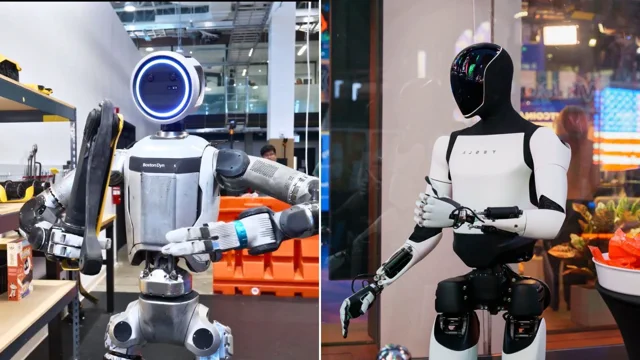
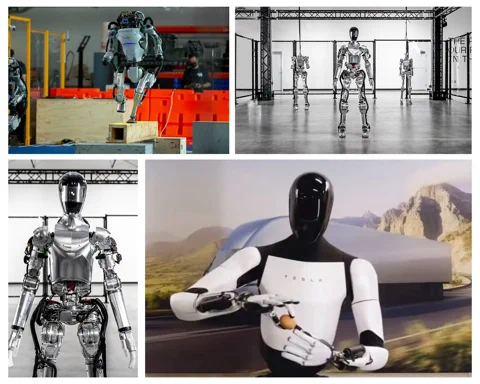
Tesla (TSLA) is arguably the largest robotics play on the public market, with Elon Musk claiming the Optimus humanoid robot will eventually be more valuable than the car business. While still in its early stages, Optimus is already being deployed in Tesla’s own factories, with mass production slated to begin in late 2026. Alongside it stands Nvidia (NVDA), the ultimate “picks and shovels” investment. Nearly every serious robotics company, including Figure AI, Agility Robotics, and Boston Dynamics, is building on Nvidia’s AI platform.

Automakers Turned Roboteers
The lines are blurring. Electric vehicle makers are leveraging their expertise in batteries, motors, and autonomous software to build humanoids. China’s XPeng (XPEV) has explicitly rebranded as a “global embodied intelligence company,” deploying its “Iron” robot in factories. Similarly, Xiaomi (1810.HK) is integrating its CyberOne humanoid into its “Human x Car x Home” ecosystem strategy.
The Private Unicorns and the IPO Pipeline
Here’s the frustrating truth: many of the most exciting names in robotics are still private. Figure AI, backed by OpenAI, Microsoft, and Nvidia, is the Silicon Valley darling. Agility Robotics, maker of the Digit warehouse robot, is backed by Amazon. And the legendary Boston Dynamics is now majority-owned by South Korea’s Hyundai Motor.
For now, direct investment is out of reach for most. The only way to get exposure is indirectly, by owning shares in their corporate parents or key partners. Keep a close watch on the Hong Kong stock exchange, however. It has become a hotbed for robotics IPOs, with companies like Horizon Robotics and UBTECH already listed, and more are expected to follow in 2026.
Risks and Red Flags: The Overcapacity Warning
Before you get too excited, let’s talk about the risks. The primary one is the AI valuation bubble. Many of these stocks are priced for perfection that may take years to materialize.
The more immediate concern, however, comes from China. In late 2025, the country’s National Development and Reform Commission (NDRC) issued a rare public warning about “blind expansion” and “overcapacity” in the humanoid robot industry. With over 150 companies rushing into the space, there’s a serious risk of a destructive price war, similar to what happened in the solar panel and EV industries. This makes careful stock selection absolutely critical. The winners will be those with a genuine software and AI advantage, not just another hardware prototype.
Your Strategic Blueprint for 2026
Navigating the robotics revolution requires a strategy. For most, a core holding in a diversified ETF like ROBO or KOID makes sense. This gives you broad exposure to the industry’s “beta” without the risk of a single company flaming out.
Around this core, you can build satellite positions in “quality” leaders with proven moats, like surgical robotics giant Intuitive Surgical (ISRG) or factory automation sensor king Keyence. Finally, a smaller, speculative allocation can be made to the high-growth, high-risk players like Tesla or Symbotic.
The robot uprising won’t be televised; it will be deployed, factory by factory, warehouse by warehouse. For investors in 2026, the challenge isn’t just picking the winners—it’s surviving the hype.