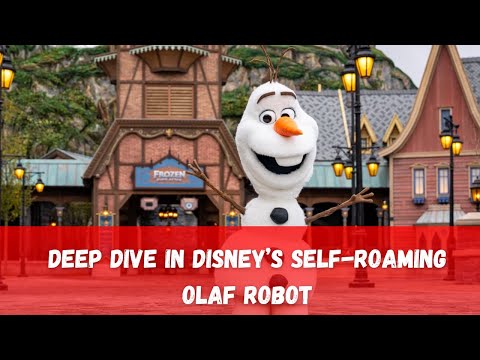
Let’s be honest. When you first saw video of Disney’s free-roaming Olaf robot, you probably thought it was just another clever animatronic, a charming but ultimately simple bit of theme park theater. We’ve seen animatronics before, and while impressive, they’re often just puppets with more expensive strings. As we briefly touched on before, Disney's AI Olaf Robot is Unnervingly Real , there’s more to this snowman than meets the eye.
Thanks to a recently published paper from Disney Research titled “Olaf: Bringing an Animated Character to Life in the Physical World,” we now have a blueprint of the ridiculously complex engineering hiding beneath that cheerful, snowy exterior. This isn’t just a puppet; it’s a 14.9 kg, 88.7 cm tall marvel of mechatronics with 25 degrees of freedom, running a sophisticated AI that has learned to walk, emote, and, most impressively, not melt itself down. Forget warm hugs; the real magic is in the thermal management.
A Design Hostile to Physics
The fundamental challenge for Disney’s Imagineers was that Olaf’s design is, to put it mildly, hostile to the laws of physics. Animated characters get to cheat. They have massive heads on stick-thin necks, tiny feet that somehow support a wobbly torso, and a gait that prioritizes personality over paltry concerns like gravity and momentum. To bring this to the real world, the team had to create a robot that could not only move like the character but also survive contact with reality—and, more importantly, with curious children.
The solutions are a masterclass in creative engineering. That iconic carrot nose? Held on by a magnet, so it just pops off harmlessly instead of becoming a hazard. The entire body is wrapped in soft PU foam, providing a built-in cushion. But the real genius lies in the legs, a problem that required abandoning conventional robotics design entirely.
The Awkward Gait of Genius
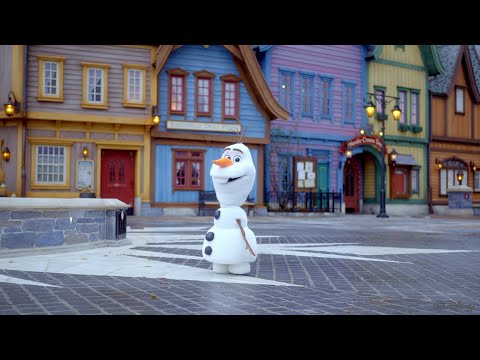
To mimic Olaf’s signature waddle, where his feet seem to slide along his spherical body, Disney’s engineers developed a pair of asymmetric, six-degree-of-freedom legs hidden entirely within a foam skirt. This clever bit of mechanical misdirection creates the illusion of the character’s impossible movement while housing the powerful actuators needed for stable locomotion.
This design gives Olaf an incredible range of expression. The legs can produce vertical motion, allowing him to change his height and emote in ways that would typically require a separate waist joint. It’s an elegant solution that packs more character into fewer, more complex components. The entire mechatronic design, from the multi-jointed neck to the intricate eye and jaw linkages, is a testament to fitting immense capability into a constrained, character-driven form factor.

An AI That Listens for Stomping
Building the body was only half the battle. Programming it was the other. Instead of being painstakingly hand-animated, Olaf’s movements are the product of reinforcement learning (RL), where an AI learns through trial and error in a virtual environment. But Disney’s team added a crucial twist: they baked real-world, aesthetic problems directly into the AI’s reward function.
Two of the biggest killers of robotic believability are noise and heat. A clanking, stomping robot doesn’t feel like a magical snowman. To solve this, the engineers rewarded the AI for quieter footsteps. The result was a staggering reduction in footstep volume, dropping from nearly 82 dB—the sound of a loud alarm clock—to a much more subtle 64 dB.
The other problem was heat. The actuators in Olaf’s skinny neck, tasked with supporting a very large head, were at risk of overheating, especially when holding a pose where he looks up. So, the team added actuator temperature to the AI’s learning objectives. The system learned to make subtle, almost imperceptible adjustments to its posture to keep temperatures within safe limits, effectively preventing a thermal meltdown.
More Than a Snowman
What Disney has created with Olaf is more than just the world’s most advanced theme park character. It’s a roadmap for the future of human-robot interaction. It demonstrates that the biggest challenges aren’t always about making a robot stronger or faster, but about making it more believable, safer, and more aware of its own physical limitations and its social context.
By translating abstract concepts like “don’t be noisy” and “don’t overheat” into mathematical rewards for an AI, Disney has bridged the gap between raw engineering and character performance. The techniques pioneered here will undoubtedly shape the next generation of robots designed to walk among us, whether in a theme park or a public square. So the next time you see Olaf, appreciate the smile, but give a respectful nod to the brilliant, heat-managing, quiet-stepping AI that makes it all possible.