Just when you thought the world of robotics couldn’t get any stranger, Shenzhen-based LimX Dynamics rolls out the Tron2. It’s billed as a “Multi-Form Embodied Robot,” which is corporate-speak for a machine that hasn’t quite decided what it wants to be when it grows up. Is it a bipedal bot that glides around on wheels like a dystopian Segway? Yes. Can it reconfigure itself into a sort of self-balancing motorcycle and pop a backflip for no apparent reason? Also yes. One commenter perfectly captured the beautiful absurdity of it all: “I didn’t know I needed a PC with legs until now.”
This isn’t just another flashy prototype destined to gather dust in a lab. The Tron2 is a masterclass in modularity, designed from the ground up as a wildly flexible research and development platform. Behind the acrobatic antics is a serious piece of hardware aimed squarely at accelerating the future of Embodied AI—intelligent agents that learn from interacting with the physical world.
A Robot with an Identity Crisis
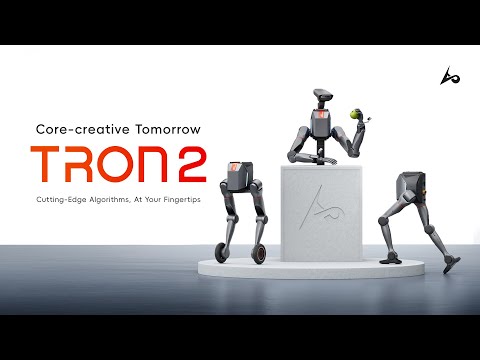
At first glance, Tron2 is a bipedal robot, but it eschews clumsy, slow-moving feet for a pair of powerful wheels. This wheeled-leg configuration allows it to zip across flat ground at up to 5 m/s (around 11 mph) and tackle slopes up to 30 degrees. But its real party trick is the transformation. The legs contort, the wheels align, and the robot morphs into a low-profile, self-balancing form that looks like something straight out of a sci-fi movie.
This isn’t just for show. The design provides extreme all-terrain mobility, allowing the robot to navigate complex environments that would stump a purely wheeled or legged machine. And yes, it can perform a full backflip in this mode, a feat of dynamic control that serves as a rather dramatic statement of its capabilities. This shape-shifting is the core of its “Tri-Form” architecture: it can be a wheeled-leg speedster, a bipedal walker for climbing stairs, or a stationary dual-arm manipulator.

More Than a Circus Act: A Developer’s Dream
While the acrobatics grab headlines, the true purpose of Tron2 is to serve the researchers and engineers building our robotic future. LimX Dynamics, a company with deep academic roots, has packed this platform with tools to streamline the notoriously difficult “sim2real” workflow.
The entire system is built to be open and accessible. Developers get a full Python development workflow, an open SDK with high- and low-level interfaces, and out-of-the-box compatibility with both ROS1 and ROS2—the de facto standard frameworks for serious robotics software development. LimX also provides the necessary URDF (Unified Robot Description Format) files, allowing developers to test and train their algorithms in simulators like NVIDIA Isaac Sim, MuJoCo, and Gazebo before deploying them on the physical hardware.
Under the Hood: Key Specifications
The Tron2 is more than just a versatile frame; it’s packed with serious hardware.
- Computing: The EDU version runs on an 11th Gen Intel Core i7 processor, providing ample power for onboard AI processing.
- Payload: In its mobile configuration, it can carry up to 30kg. When configured as a stationary unit, its dual 7-DoF arms can handle a combined payload of 10kg.
- Speed: It achieves up to 5 m/s in wheeled mode and 2-3 m/s when walking on its “sole feet” modules.
- Battery: A 9Ah ternary lithium battery supports fast charging, hitting 80% capacity in just 30 minutes, and is designed to be swappable for continuous operation.
- Sensors: The research-focused EDU edition is loaded with RGBD cameras at the head, waist, and wrists, along with a high-precision IMU for robust perception.
The Lego Approach to Humanoids
Here’s where Tron2 moves from merely interesting to genuinely groundbreaking. The entire platform is modular. Don’t need legs? Swap them out for a pair of 7-DoF arms with a 70cm reach and human-like spherical wrists, turning the base into a highly capable stationary manipulation platform.

The ultimate expression of this modularity is the ability to combine two separate Tron2 bodies. By connecting two units, researchers can create a quadrupedal robot for enhanced stability or even assemble a full-sized humanoid. This “build-a-bot” approach provides an unprecedented level of flexibility, allowing a single lab to experiment with multiple robot morphologies using one core hardware investment.
This strategy directly addresses a major bottleneck in robotics research: the high cost and specificity of hardware. By creating a versatile, reconfigurable platform, LimX is lowering the barrier to entry for advanced research into motion control and Vision-Language-Action (VLA) models.
The Price of Progress
So, what does this shape-shifting, backflipping marvel cost? LimX Dynamics is positioning the Tron2 as an accessible platform for research and education. Recent reports indicate the base model starts around $7,000, while the comprehensive “3-in-1” EDU Edition, which includes all the modules for every configuration, is priced around $25,000.
While not exactly a consumer-grade price tag, it’s remarkably aggressive for a research platform with this level of capability. For university labs and corporate R&D departments, the Tron2 represents a powerful, multi-purpose tool that could significantly accelerate the development of next-generation robots. It’s a weird, wonderful, and surprisingly practical glimpse into a future where our machines are as adaptable as the problems we ask them to solve.