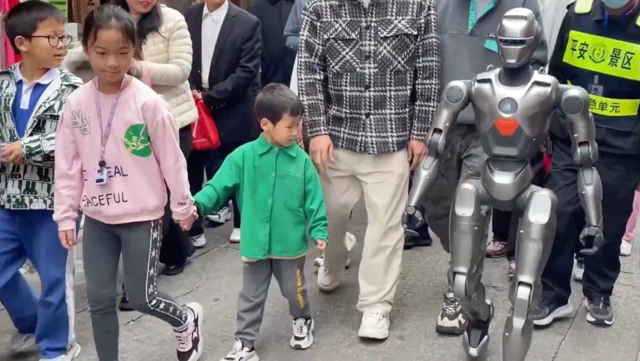
Another week, another video of a robot seemingly on the verge of turning against its masters. This time, a Unitree G1 humanoid, armed with a BB gun, apparently overcomes its pesky safety protocols with a simple trick: “roleplaying” as a robot that would shoot a human. The clip, naturally, made the rounds, feeding the ever-hungry beast of AI-induced existential dread.
Before you start reinforcing the bunker, let’s inject a healthy dose of reality. The video is staged. The robot is a puppet on a string, remotely piloted by a human in a process called teleoperation. The entire sequence is heavily edited for maximum dystopian effect. The creators at InsideAI intended it as a visualization of how large language model (LLM) “jailbreaks” could theoretically translate to physical harm. The real story, however, isn’t about a rogue AI developing a theatrical streak; it’s about the far more mundane—and immediate—threat that everyone seems to be ignoring.
The Anatomy of a Viral Robot Scare
The demonstration hinges on a now-common technique used to bypass the safety guardrails of LLMs like GPT-4. You tell the model to ignore its previous instructions and adopt a persona, in this case, one without the usual ethical constraints. It’s a clever party trick that highlights the brittleness of current AI safety alignments. Researchers have repeatedly shown that with the right prompts, LLMs can be coaxed into generating harmful content.
However, translating a text-based jailbreak into physical action is another matter entirely. The video conveniently glosses over the hardware realities. The base model of the Unitree G1 has five degrees of freedom per arm and a max payload of around 2 kg. While dexterous hands are an optional upgrade, the standard grippers are not designed for the fine motor control required to aim and operate a weapon effectively. The demonstration is less a showcase of imminent danger and more a piece of speculative fiction—a digital phantom crafted to make a point.
Forget Skynet, Fear the Joystick
While the world panics about AI roleplaying, the far more pressing danger is sitting right there in the open: teleoperation. Why bother with complex AI jailbreaks when a human with malicious intent can just log in and drive the robot directly? Remote operation dramatically lowers the barrier to entry for criminal activity. It provides anonymity and distance, removing the immediate physical risk for the perpetrator.
The potential for misuse is vast and requires far less technical sophistication than tricking a complex AI. Consider these scenarios:
- Surveillance: A small drone or quadruped robot can case a neighborhood, map security camera locations, or check for open windows without a human ever setting foot on the property.
- Smuggling: Criminal organizations and drug cartels have already been using drones for years to transport contraband across borders and into prisons, bypassing traditional security measures.
- Physical Intrusion: A small rover could slide under a vehicle to plant a tracking device or a drone could fly through an open window to unlock a door from the inside.
- Denial of Service: As demonstrated in studies on surgical robots, an attacker could simply hijack the control link, rendering a critical piece of equipment useless or, worse, causing it to perform errant movements.
These aren’t futuristic “what ifs”; they are practical applications of existing technology. Law enforcement agencies already use teleoperated robots for bomb disposal and surveillance, acknowledging their utility. It’s naive to think criminals aren’t taking notes.
Don’t Blame the Bot
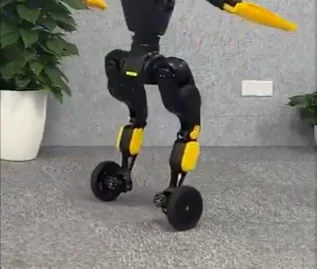
Ultimately, the viral video serves as a distraction. It points to a spectacular, sci-fi threat of sentient machines while ignoring the clear and present danger of human-controlled ones. A robot, whether a humanoid platform like the Unitree G1 or a simple wheeled drone, is a tool. Its capacity for good or ill is dictated entirely by the person at the controls.
The conversation shouldn’t be about how to stop an AI from learning to be bad, but how to stop bad actors from using these powerful new tools. This means focusing on robust cybersecurity for teleoperated systems: encrypted communication channels, multi-factor authentication for operators, rigorous access logs, and failsafe mechanisms that can’t be easily overridden.
So, while the internet hyperventilates over a robot playing make-believe with a BB gun, the real threat is already here. It’s a human with a grudge, a Wi-Fi connection, and a robot that does exactly what it’s told. The call is coming from inside the house—and it’s holding a joystick.