Human history is tightly linked to the tools we build. Early humans shaped stone axes to become stronger and made fire-starting tools to survive the cold. These innovations served one shared purpose: extending the limits of the human body. Faster, stronger, more precise or more capable—we have always used tools and machines to get there. The pattern runs through agriculture (from ploughs to combine harvesters), industry (from hammers to robot arms) and transport (from horses to cars). It becomes especially fascinating in electronics and computing, where tools move ever closer to us and almost become part of us. This article explores how AI and robotics may continue that trajectory.
The evolution of computers and gadgets
The history of computing is a perfect example of tools becoming more intimate and more augmentative. In the 1940s, electronic computers such as ENIAC filled entire rooms and could be operated only by specialists. They helped people from a distance: they calculated faster than the human brain, but remained physically separate.
In the 1970s, personal computers such as the Apple II and IBM PC moved onto our desks. They brought computing power into offices and homes, allowing people to interact with it through a keyboard and screen. The portable-computing revolution followed. Laptops let us carry a computer with us, tablets made that even easier, and smartphones eventually put almost everything in our pockets. Since the iPhone launched in 2007, the computer has become something we hold in our hands. A modern smartphone is faster than many old supercomputers—and always within reach.
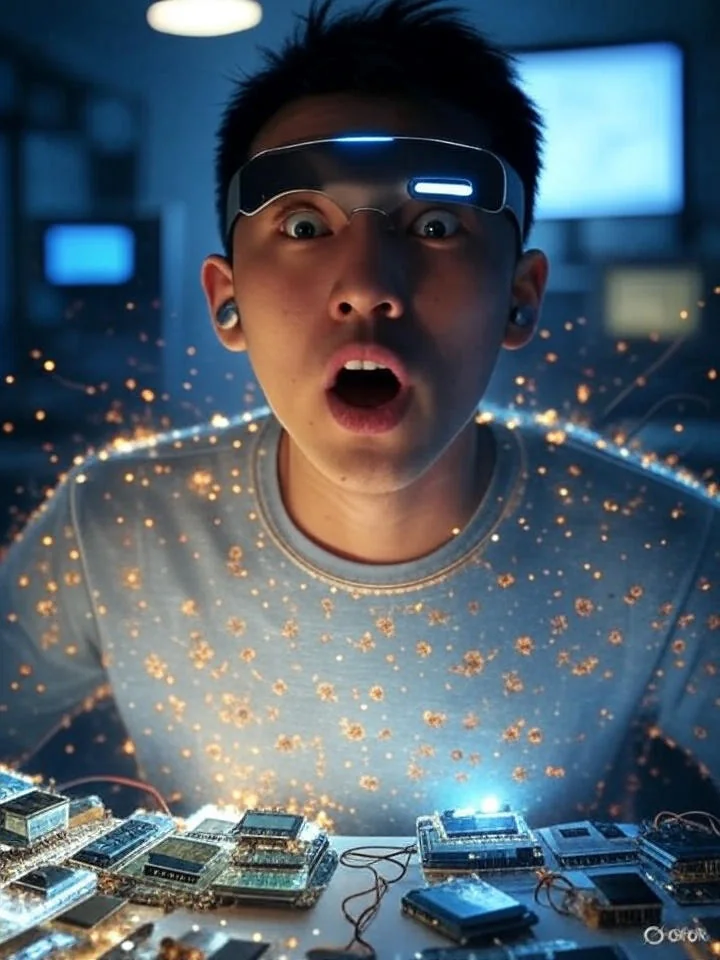
The process has not stopped. Smartwatches such as the Apple Watch monitor our heart rate, count steps and deliver notifications from the wrist. Smart glasses, including the successors to Google Glass and Meta Ray-Ban, and smart rings push the same trend further. Today they mainly measure sleep and health, but they could become interfaces too. I have imagined using a ring as a touch surface for scrolling, volume control or even mouse movement; Apple patented a similar idea years ago, while Meta is exploring wrist-based control for its glasses.
The direction is clear: devices are becoming smaller, closer and more integrated with the body. They do not merely supplement our senses and abilities; they increasingly extend them—and, in a sense, our brains.
The phone is already an external memory and communication organ. We store, collect and retrieve information through it every day.
Where we are heading
This is no longer science fiction: some people have a “chip in their brain”. Brain–computer interfaces (BCIs) have been studied for decades, and Neuralink reported a 2024 implant that allowed a patient to control a computer with thought. The immediate benefit is restored capability—for example, helping paralysed people move or interact virtually. It may be only the beginning of a much larger integration between people and machines.
Experimental exoskeletons from companies such as Hyundai and SuitX assist muscles in factories, rehabilitation and defence. Robotic prostheses can already be controlled by thought, returning movement to people who have lost a limb.
Neuralink update, summer 2025
Elon Musk argues that robots could become part of human augmentation. In a recent demonstration, a person controlled a robotic hand; eventually, a Tesla Optimus humanoid might be operated remotely—even through signals from the brain. Musk has suggested that people with Neuralink implants could receive full-body control and sensory feedback from an Optimus, as if they were inhabiting the robot. That could let workers perform dangerous tasks from a safe distance or extend their physical presence across a continent. Neuralink has also announced research connecting an implant to a robotic arm to test thought control.
Man Who Is Paralyzed Uses an AI-Driven Brain Implant to Control a Robotic Arm
AI is central here too. These systems do not merely extend the body mechanically; they can adapt intelligently and learn from their users.
Musk uses an interesting analogy: just as the cortex serves the limbic system, AI could play a supporting role for biological minds. His view is that the brain is itself a biological computer and that neural interfaces might eventually help compensate for damage such as a stroke. These are ambitious claims, not settled clinical conclusions, but they show where the debate is heading.
And we have not even reached the most capable robots. I often argue that we should prepare for machines becoming better at almost everything. We need to accelerate our own learning too. The age of augmented people is approaching.
The age of the augmented human
Humanity has always tried to exceed its physical limits, and electronics are taking that effort to a new level. The path from room-sized computers to brain implants shows how tools are becoming part of us. With AI and robotics, we may become not omnipotent, but more capable, better informed and able to act through machines at a distance.
The risks are real: privacy, ethics, control and social inequality if only the wealthy can access these capabilities. Innovation must serve people, not the other way around. We should stay alert so that the new abilities delivered by augmentation, AI and robotics genuinely improve human lives.