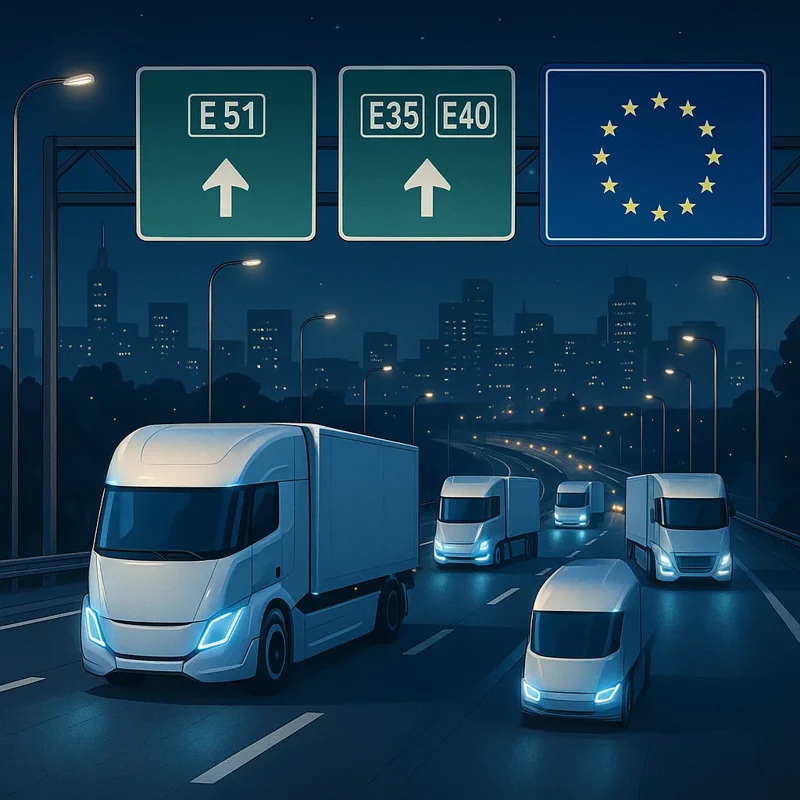
The technology behind self-driving trucks is rapidly evolving on a global scale, and Europe is playing a pivotal role, particularly in the logistics and transportation sectors. In response to driver shortages, cost efficiency, and sustainability demands, numerous European and global companies are actively developing autonomous trucks. The regulatory frameworks within the EU, especially in Germany, are facilitating these advancements, although widespread implementation is still on the horizon.
Key Companies and Developments
The table below summarizes the major players developing self-driving trucks in Europe:
| Company | Headquarters | Main Activities | Partners/Collaborations | Timeline |
| MAN Truck & Bus | Germany | Series production of zero-emission autonomous trucks by 2030, Hamburg TruckPilot, ANITA project | HHLA, Deutsche Bahn, Fresenius University, Götting KG | 2030 (goal) |
| Scania | Sweden | Testing autonomous trucks on the Swedish E4 highway, hub-to-hub traffic | TRATON, TuSimple | Testing since 2021 |
| Iveco | Italy | Working with Plus.ai for closed-course and soon public road testing | Plus.ai | Public testing coming soon |
| Daimler | Germany | Developing autonomous trucks in collaboration with Waymo | Waymo | Ongoing |
| Volvo | Sweden | Long-haul autonomous freight development with Aurora and Waabi | Aurora, Waabi | Ongoing |
| Einride | Sweden | Developing autonomous electric trucks, tested in closed environments | – | Closed testing |
| Plus.ai | Global | AI-based autonomous technology, collaborating with TRATON, Hyundai, Iveco | TRATON, Hyundai, Iveco, Amazon, DSV, Transurban | Ongoing |
| TRATON | Germany | Parent company of MAN and Scania, planning series production by 2030 | Navistar, TuSimple | 2030 (goal) |
Regulatory Framework
The EU is working towards legalizing fully autonomous trucks and buses (SAE Level 4), gradually reducing the need for human drivers. Germany was the first country to pass legislation in 2021 allowing Level 4 autonomy in designated areas, such as logistics terminals, under human supervision. This legal framework is crucial for broader technology adoption, particularly in hub-to-hub traffic, where routes are relatively straightforward.
Benefits for Carriers
Self-driving trucks offer a plethora of advantages for carriers:
- Efficiency and Cost-Effectiveness: They reduce labor costs, which are the second-largest expense after fuel. A university study in Michigan indicates that Level 4 vehicles could lower fuel consumption by up to 9%.
- Addressing Driver Shortages: In Germany, around 30,000 truck drivers retire each year, while only about 17,000 new drivers enter the workforce, creating a significant challenge. Autonomous trucks enable 24/7 operations, alleviating the burden on human drivers.
- Sustainability: The development of zero-emission trucks, like those from MAN and Einride, helps reduce carbon footprints, aligning with green logistics trends.
In Europe, hub-to-hub traffic appears to be the most promising area for self-driving trucks, as these routes tend to be simpler and involve high-volume transport between logistics hubs. According to TRATON’s CTO, Catharina Modahl Nilsson, this domain is feasible in the short term, with series production expected by 2030. However, regulatory hurdles, such as UNECE Regulation No. 157, may limit the introduction of higher autonomy systems, particularly in urban environments.
Autonomous Driving in Hungary
Hungary is also emerging as a significant player in this sector. The country is home to innovative companies like AiMotive and Commsignia, which are developing camera and AI-based autonomous solutions. These enterprises contribute to Hungary’s positioning as a key hub in the global self-driving vehicle industry. The government supports this sector by establishing the ZalaZone test track in Zalaegerszeg, which is Europe’s first 5G-based autonomous vehicle testing facility. This track allows various companies to test autonomous technologies and underscores Hungary’s commitment to the development of self-driving vehicles.
| Region | Regulation/Details | Timeline | Key Information |
| EU/Hungary | UNECE regulations, including DCAS, effective January 2024 | N/A | Safety and performance standards for ADAS, an intermediate step towards fully autonomous vehicles |
| Hungary | ZalaZone test track, 5G-based, open to companies | Since 2019 | Key infrastructure for testing autonomous technologies |
| Hungary | Government incentives, including R&D, tax breaks, and cash support | Ongoing | Support for investors, especially in technology innovation and capacity building |
| EU | UNECE Regulation No. 157, ALKS, with speed restrictions and driver verification | N/A | Limits higher autonomy, impacting the rollout of Tesla FSD |
Domestic Companies and Academic Projects
Several companies are actively developing autonomous technology in Hungary. AiMotive, which was acquired by Stellantis in 2022, plays a crucial role in developing AI-based autonomous systems. Continental also has a significant presence with an R&D center in Budapest focused on autonomous driving technologies.
The academic sector is engaged as well, with BME launching an autonomous vehicle control engineering program and collaborating with companies like Bosch, Knorr-Bremse, and Continental through its RECAR (Research Center for Autonomous Road vehicles) initiative.