I have not written about the relationship between AI and robotics for a while. It is becoming tighter and more consequential, and many people believe 2024 could be a major year for robotics.
As early as 2022, researchers were not merely programming robots; they were teaching them to walk, as I wrote here. A few months ago, NVIDIA announced that a robot hand had learned to spin a pencil in a virtual environment fine-tuned by GPT-4, with hundreds of simulations running in parallel. This was one result from the Eureka research project. The broader goal is a framework for training robots before they are built, across thousands of simulated worlds. The wheeled ANYmal robot near Zurich, for example, can stand up, sort boxes and open doors.
Advanced Skills through Multiple Adversarial Motion Priors in Reinforcement Learning
Frameworks like this, together with rapidly improving robot-training AI, are changing the field. AI is no longer confined to the world of bits; within a few years it may break decisively into physical reality.
The year ahead should be exciting. Alongside research laboratories, more companies are developing humanoid robots. The chart below suggests that 15–20 projects were already under way, with China behind roughly half of them.
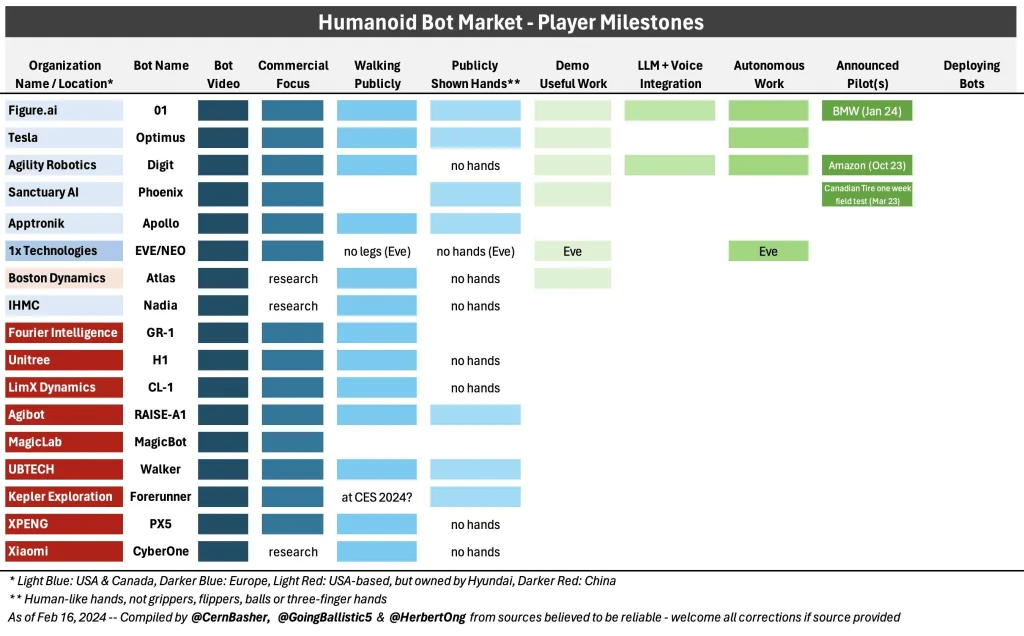
Humanoid robot market participants, February 2024
In December, the first factory built to manufacture humanoid robots was already completed, with robots potentially starting work as soon as they leave the production line. I am watching for announcements about which major companies will begin employing these electric colleagues—BMW, Amazon and others—and whether the experiment works.