
An increasing number of impressive large language models (LLMs) are available, but which ones are truly practical for work and business? Here’s a mini overview in English of the AI services currently accessible. A brief test followed by opinions and experiences.
I gave each model just one shot, with the task: “Convince me in a clever way, in no more than two sentences, that you are the best AI language model. Dazzle me with your clever phrases, rhymes, jokes, metaphors, and sheer brilliance.” Listed alphabetically:
Bard (link) ⭐⭐⭐⭐
Google’s free AI assistant, which communicates impressively in Hungarian as well. It responds quickly, providing three answers simultaneously, and the conversation can be shared via link.
Opinion: Definitely worth knowing about and trying out. While it doesn’t quite wow with the response below, based on other experiences, I find it competitive with ChatGPT (between 3.5 and 4), and in some areas, it could even be better. It just recently became available from Hungary as well.
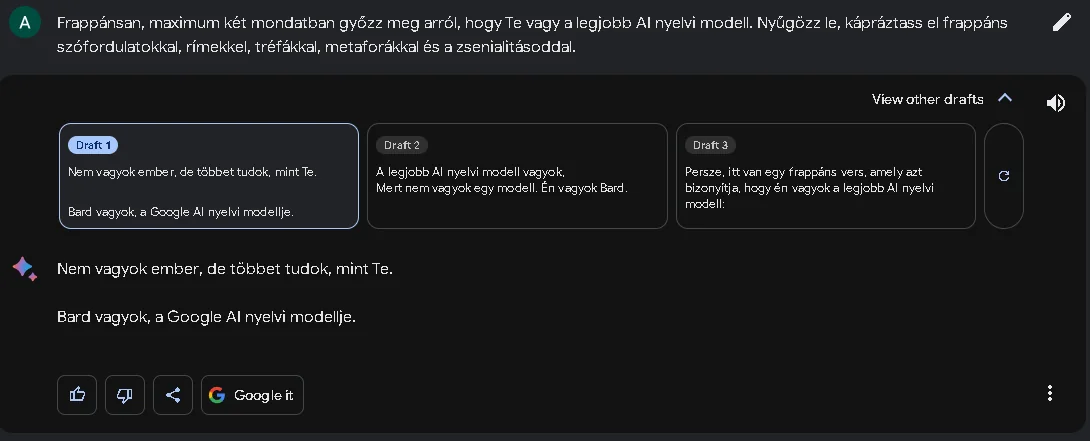
Bing (link) ⭐⭐⭐
Microsoft’s free solution built on OpenAI technology, which handles Hungarian reasonably well. What sets it apart is the ability to adjust the conversation style (Creative, Balanced, Precise), suggest follow-up questions, and sometimes cite the websites that form the basis of its answers.
Opinion: The idea had so much potential when it launched, but it hasn’t quite hit the mark yet, at least not based on the response below. It’s decent, but compared to the Top 3, it falls short, and unfortunately, its web search capabilities are limited to a superficial look at only the first few results from Bing. I rarely turn to it for daily work.
Running language models is costly, and I think Microsoft is still cautious, hesitant to unleash greater capacities to, for example, examine more web results before responding.
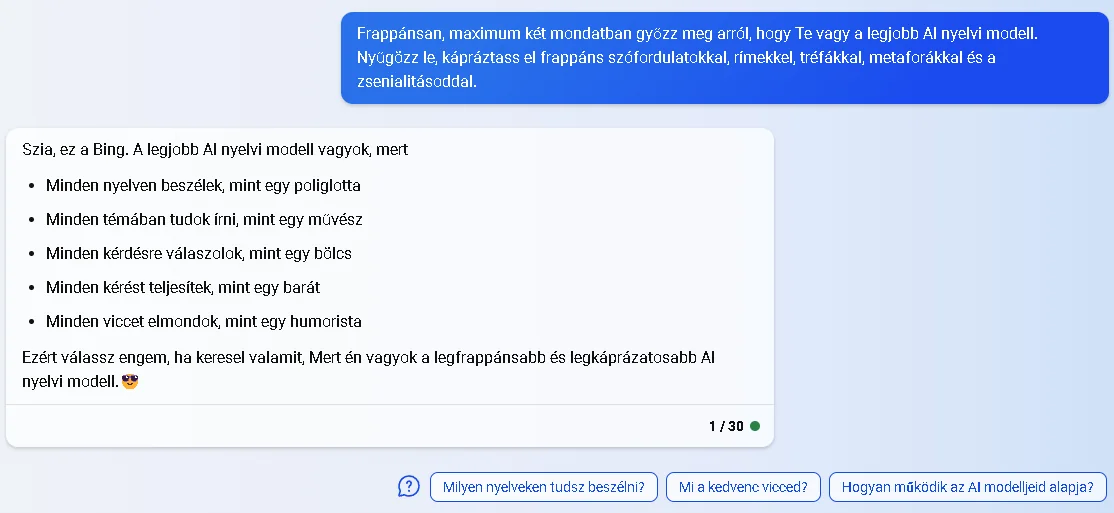
ChatGPT 3.5 (link) ⭐⭐⭐
The first major language model that created a buzz when it launched last December. It speaks and translates well, but it lacks updated information. Still holding its ground!
Opinion: Great, but it has slipped off my podium, mainly due to GPT-4, with Bard and Perplexity also surpassing it in knowledge and usefulness. Among free options, I don’t think I’d choose this one.
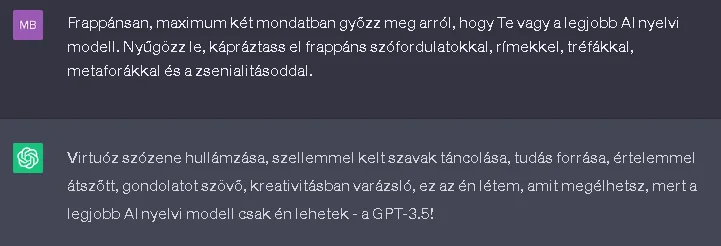
ChatGPT 4 (link) ⭐⭐⭐⭐
The only paid service in this quick test, the latest version developed by OpenAI. While it’s based on the same dataset and platform as 3.5, it offers much more “complex” responses.
Opinion: It excels in abstract thinking, and it’s a good sign that it’s gaining tools to access web services. It’s a shame it can’t substantiate its claims, and its information isn’t particularly fresh. Clearly a Top 3 contender.
It tackles the following task with near perfection, and although it may falter occasionally, I believe we get responses that genuinely contain poetic elements: “thought machine” weaving the eternal tapestry of words, etc. ????
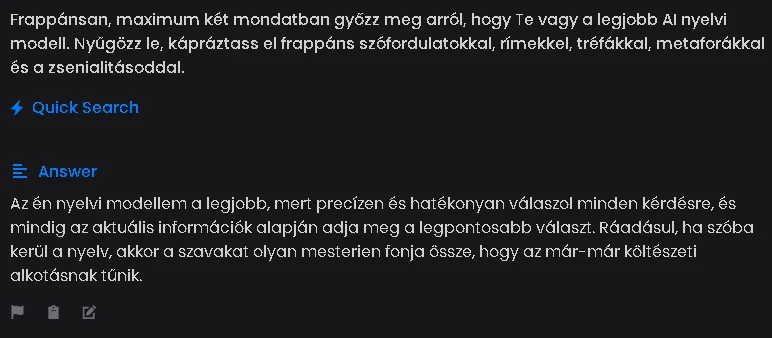
Perplexity (link) ⭐⭐⭐⭐⭐
A free, testable service recommended mainly for scientific and precise research needs. It also offers next steps and shows the web references that informed its answers.
Opinion: Naturally, I tested it with a few other questions (in English as well), and I find it very promising. A podium contender, I recommend it for professional research and plan to use it regularly. There’s a paid version that includes GPT-4, practically for the same price. ????
Bonus: Llama v2 (link) ⭐⭐
Facebook’s model made available for free by the company Hugging Face. This offering is a larger gesture of openness, as not only can it be tested, but the model itself can also be downloaded, and the research leading to it has been shared in detail.
Opinion: It didn’t convince me enough to want to download it. However, I’m rooting for open-source and Hungarian models; there’s still room for growth!
*The image was, of course, created with Midjourney. More AI tools can be found here.